Every exam cell knows the week before finals: a duty chart with gaps in it, faculty swapping slots, and a controller of examinations counting rooms against the number of people available to stand in them. The invigilator is the least glamorous role in assessment and the one the whole system leans on. This guide sets out what invigilators do, how many an exam needs, where the rules come from, and what changes when the hall is replaced by a screen.
What an invigilator is
An invigilator is the person responsible for the conduct of an exam in the room where candidates sit it. The Cambridge Handbook 2026 gives the role four jobs: make sure the exam follows the regulations, keep it secure before, during and afterwards, prevent and report suspected malpractice, and prevent administrative errors (section 4.6). England's exam regulator, Ofqual, puts it more plainly: exams officers and invigilators are responsible for the practical running of exams, including administering papers, supervising candidates and maintaining exam conditions.
Invigilator is the usual word in India, the UK and most Commonwealth systems. In the United States the same person is a proctor, which is why the software that does this job online is sold as proctoring. We cover that side in What Is Proctoring?; this article stays with the person in the room, and then follows the role online.
What invigilators do before, during and after an exam
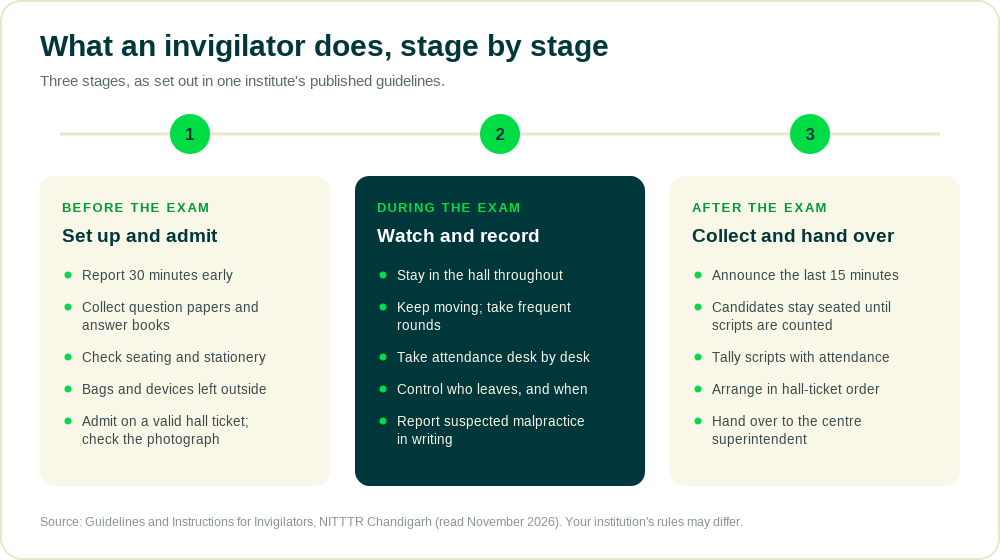
The duties are remarkably consistent from one institution to the next. Two published Indian examples show the pattern: the guidelines for invigilators at NITTTR Chandigarh, a national technical teachers' institute, and the examination procedures of Bhaskaracharya College of Applied Sciences, University of Delhi.
Before the exam
At NITTTR, invigilators report to the control room at least 30 minutes before the start and collect question papers and answer books 15 minutes before. In the hall they check the seating, the supply of answer books and supplementary sheets, and that bags, books and laptops are left in the designated area. No candidate enters without a valid hall ticket. The invigilator checks the photograph on it and, where there is doubt, asks for a second identity card.
During the exam
The core instruction is to be present and to keep moving. NITTTR's guidelines ask invigilators to stay in the hall for the whole exam and take frequent rounds; the Delhi college's procedure says never to leave the room or the exam materials unattended. Invigilators control movement: at NITTTR nobody leaves in the first 30 minutes or the last 15, and a candidate who has to step out for a medical emergency is accompanied. They also complete attendance by going to each candidate, instead of passing the signature sheet around the room.
When an invigilator suspects malpractice, the procedure is to act quietly and write it down. Prohibited material is confiscated, the centre superintendent is told immediately, and a written report goes in with the answer booklet. The invigilator records what happened. Someone else decides the consequence.
After the exam
The end of an exam is where scripts go missing, so the rules are strict. Candidates stay seated and silent until the number of scripts collected matches the number of candidates present. Scripts are arranged in hall-ticket order and handed to the centre superintendent, unused stationery is returned, and at NITTTR all the invigilators in a hall are collectively responsible for the safe return of the answer books.
How many invigilators an exam needs
There is no single national number, so check the regulations you run under. Two published rules give a sense of the range.
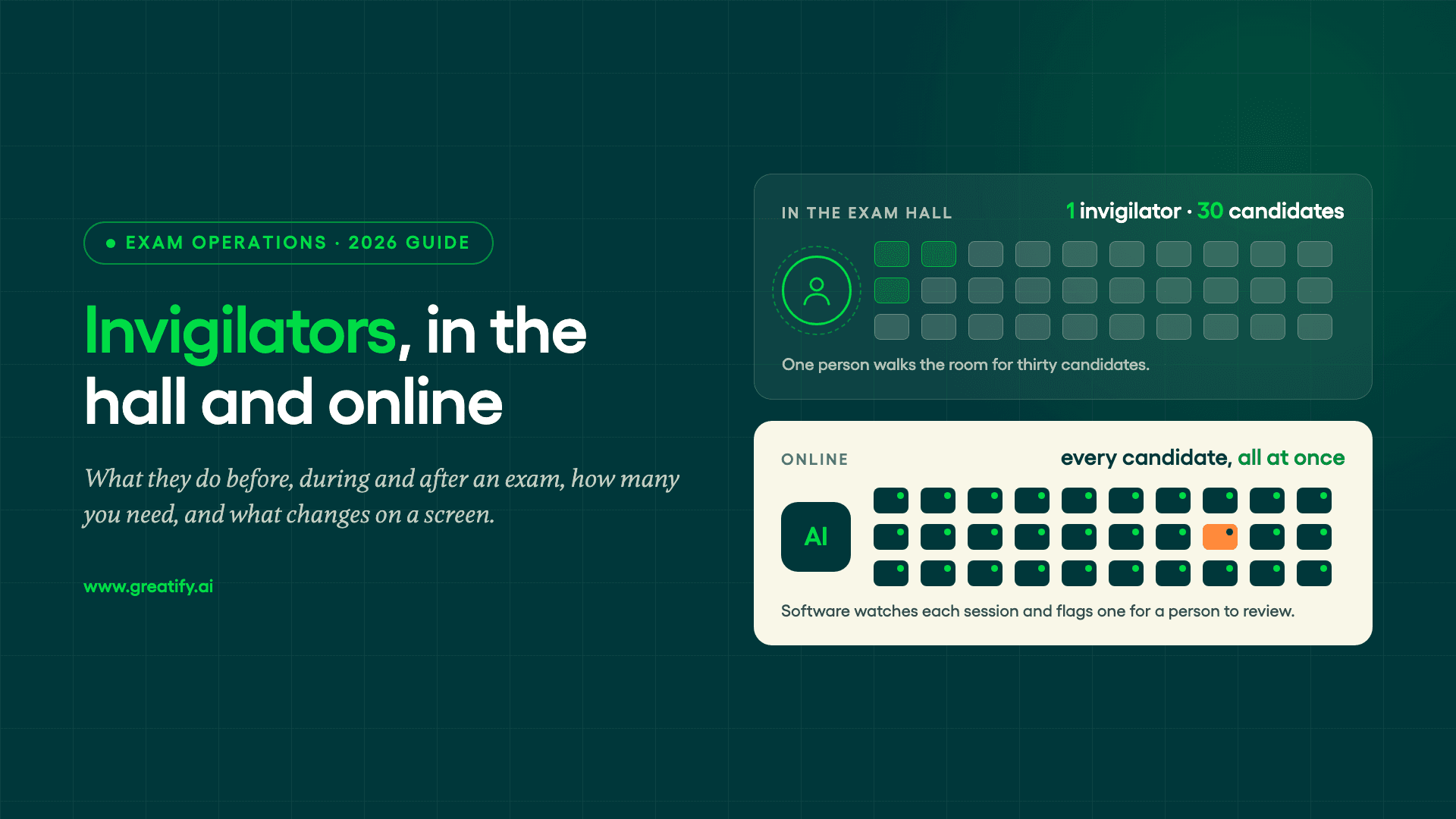
- Cambridge International: at least one invigilator for every 30 candidates, with every candidate visible to an invigilator at all times. Practical tests need at least two invigilators in each room, and the ratio must not drop below 1 to 20 (Cambridge Handbook 2026, section 4.6).
- NITTTR Chandigarh: normally at least two invigilators for each examination hall, drawn from teaching staff.
Both sets of rules also deal with conflicts of interest. Cambridge says a teacher who prepared the candidates for the exam must not be the only invigilator at any time. NITTTR goes further: subject teachers are not posted to halls where students are writing that subject, and invigilators must disclose in advance if a close relative is a candidate.
Do the arithmetic for a large university and the staffing problem is obvious. At one invigilator per 30 candidates, an exam session with 6,000 candidates needs 200 people in rooms, before reserves, flying squads and the control room. That is 200 members of staff who are not teaching or evaluating for the length of that session, and the count repeats every session of the exam season.
What invigilators must not do
The limits matter as much as the duties, because an invigilator who helps is as much of an integrity problem as one who looks away. Under the Cambridge Handbook 2026, invigilators must not prompt or help candidates with answers, tell them which questions to answer or when to move on, explain the meaning of words in the paper, or point out errors in a candidate's work. NITTTR's guidelines add the housekeeping version: invigilators do not carry mobile phones or reading material into the hall, and do not chat.
Invigilation online: the same job through a camera
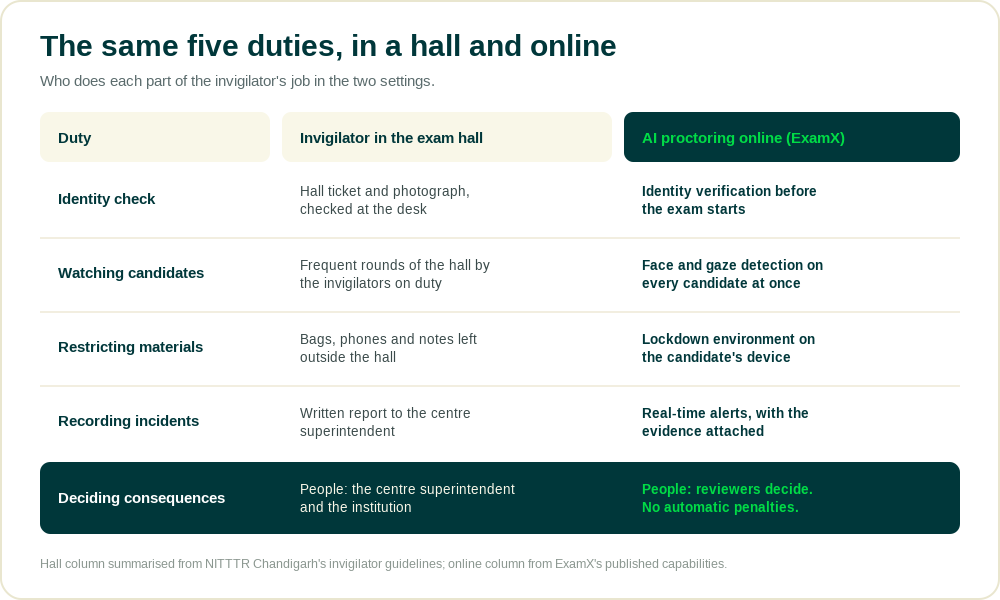
When candidates sit an exam away from the hall, the duties do not change. Someone still has to confirm identity, watch the session, and record anything irregular. What changes is who does the watching.
Boards now use the term directly. In March 2026, CBSE announced an Online Remote Invigilation Examination (Proctored Assessment) for school counsellors: a phased assessment of approximately 10,000 counsellors across its affiliated schools, run on an AI-enabled platform, with the first batch started in February 2026.
Online invigilation comes in a few forms: a remote person watching live, a recording reviewed afterwards, or software monitoring every candidate at once. We compare them in Automated Proctoring vs Live Proctoring. The automated form is the one that removes the staffing arithmetic above, because it does not need one watcher per thirty candidates.
This is how AI proctoring in ExamX works. Identity is verified before the exam starts. During it, the system tracks face and gaze, and raises real-time alerts for multiple faces, device swaps and off-screen activity, inside a lockdown environment that restricts the device. ExamX reports 99.2% detection accuracy with under 0.1% false positives, and supports 100,000+ concurrent candidates. Flags go to human reviewers with the evidence attached, and no penalty is applied automatically. That last point is the invigilator's rule carried over intact: record what happened, and let someone with authority decide.
What software does not replace
An honest account of online invigilation has to include what it cannot do.
- Judgement. A flag is an observation. Whether a candidate glancing away was reading a note or thinking is a decision for a person, with the recording in front of them.
- Care for the candidate. A hall invigilator notices the student who is unwell, escorts someone out, and applies an approved accommodation. Online, institutions need a support line and a clear procedure for technical failures, because the camera will not provide either.
- Live intervention by a person. Some licensure and accreditation rules require a human proctor who can step in mid-exam. ExamX does not offer a live human proctor option; its proctoring is automated, with human review of flags. If your regulator requires a live proctor, you need a service built around one.
- A controlled room. At home, the candidate's device, connection and surroundings are theirs. For the highest-stakes exams, many institutions keep candidates on campus for that reason.
Digital exams still happen in halls
Online invigilation and digital exams are different decisions. Plenty of institutions move the exam onto a device and keep the hall. SRM Institute of Science & Technology ran 80,000+ fully paperless exams on ExamX across five campuses, on about 2,000 tablets, over 45 continuous days and with zero examination disruptions (read the SRM case study).
In a digital hall the invigilator's paper-handling work disappears: there are no question paper packets to collect or answer scripts to count and carry. At SRM, scripts were ready for evaluation in about 10 minutes, compared with about a week on paper. The watching, the identity check and the duty of care stay with people in the room. If you are weighing the two models, Online Exam Software vs Traditional Exams walks through the trade-offs.
A short checklist for exam cells
- Write the ratio down. State how many invigilators each room needs and whose regulation that number comes from.
- Settle conflicts of interest in the duty chart, not on the morning of the exam: subject teachers, relatives of candidates, and anyone who prepared the cohort.
- Train on the report, not only the rules. Invigilators should know exactly what to write, and who receives it, when they suspect malpractice.
- Separate observing from deciding. In a hall or online, the person or system that flags an incident should not be the one that sets the penalty.
- If you go online, ask for two numbers from any vendor: detection accuracy and the false-positive rate. Then ask to see the review workflow. Our guide to preventing cheating in online exams lists the rest.
FAQs
What is an invigilator?
An invigilator is the person responsible for the conduct of an exam in the room where it is taken. They check that the right candidates are present, keep papers and scripts secure, watch the room for the whole session, and report anything irregular. In the United States the role is usually called a proctor.
What are the duties of an invigilator?
Before the exam, invigilators collect papers and answer books, check the seating and admit candidates against their hall tickets. During it, they stay in the room, keep moving, control who leaves and stop candidates communicating. Afterwards they collect the scripts, tally them against attendance and hand them over. Suspected malpractice is reported in writing.
How many invigilators are needed for an exam?
It depends on your regulations. The Cambridge Handbook 2026 requires at least one invigilator for every 30 candidates in written exams, and at least two in the room for practical tests with a ratio no lower than 1 to 20. NITTTR Chandigarh's guidelines say at least two invigilators are normally appointed for each hall.
What is the difference between an invigilator and a proctor?
Mostly geography. Invigilator is the usual word in India, the UK and most Commonwealth systems; proctor is the American one. Online, the software is called proctoring almost everywhere, although some boards say remote invigilation.
What is remote or online invigilation?
It is supervision of an exam taken away from the hall, through the candidate's webcam, microphone and screen. A remote person can do the watching, software can, or both. CBSE used the term in March 2026 for a proctored assessment of school counsellors.
Can AI replace human invigilators?
It can replace the watching, which is the part that does not scale. It should not replace the judgement. In ExamX, AI monitors every candidate at once and raises flags with evidence; people review them and decide, and no penalty is applied automatically.
The bottom line
The invigilator's job is the same in every rulebook we read: confirm who is in the room, keep the paper secure, watch, and write down what happened. What technology changes is how much of that a person has to do. Digital delivery removes the paper handling. AI proctoring takes over the watching and scales it past any duty chart. The judgement, and the responsibility for the candidate, remain with your staff.
ExamX covers authoring, delivery, online proctoring and AI evaluation on one platform, and you can see how it sits beside other platforms on our comparison pages. If your exam cell is planning its next season, Book a demo and we will show you both the hall and the online model.