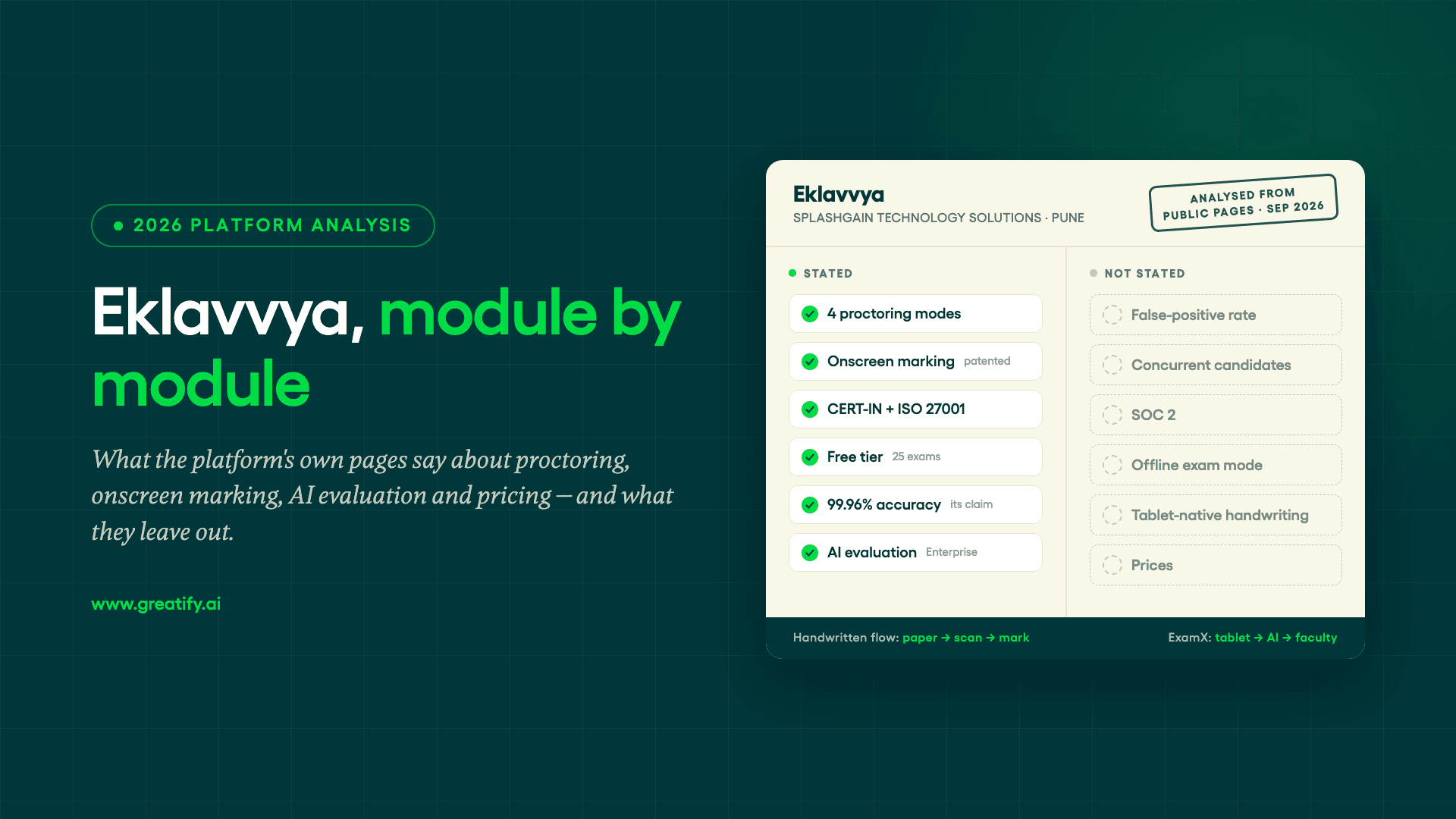
Eklavvya turns up in almost every Indian university's exam-software shortlist. (People also search for it as "Eklavya"; the product spells its name with two v's.) This analysis is written from Eklavvya's public pages — product pages, pricing page and published case studies — read in September 2026. We have not run a hands-on trial, and we are a competitor: Greatify builds ExamX. Read it as a summary of what Eklavvya says about itself, the questions we would put to it in a demo, and where our own product differs.
The short version: Eklavvya is a broad assessment suite with an unusually long module list and a widely adopted onscreen-marking product for paper answer sheets. Its thinnest published area is the one it markets hardest, AI: the accuracy figure is its own, the evaluation layer is new and Enterprise-only, and the handwritten workflow still starts on paper.
What Eklavvya is, and who builds it
Eklavvya is a product of Splashgain Technology Solutions Pvt. Ltd., a Pune company founded by Swapnil Dharmadhikari (Founder and CTO, previously at TCS and Geometric Software) and Samir Kamat (Co-founder, MD and CEO). Its about page describes it as "a plug-and-play platform for objective tests, coding challenges, voice-based assessments, and AI interviews", and Splashgain's company page states 500+ customers in 17+ countries, CERT-IN certification, and an India and worldwide PCT patent for its onscreen marking system. Those are the vendor's figures, which we could not verify independently; the same applies to every number attributed to Eklavvya below.
It sells to two markets at once: universities, school boards, entrance-exam bodies and public service commissions on one side; recruitment aptitude tests, employee skill assessments, video interviews and psychometric tests on the other. That dual footprint explains its breadth, and a few of its seams.
The Eklavvya module map
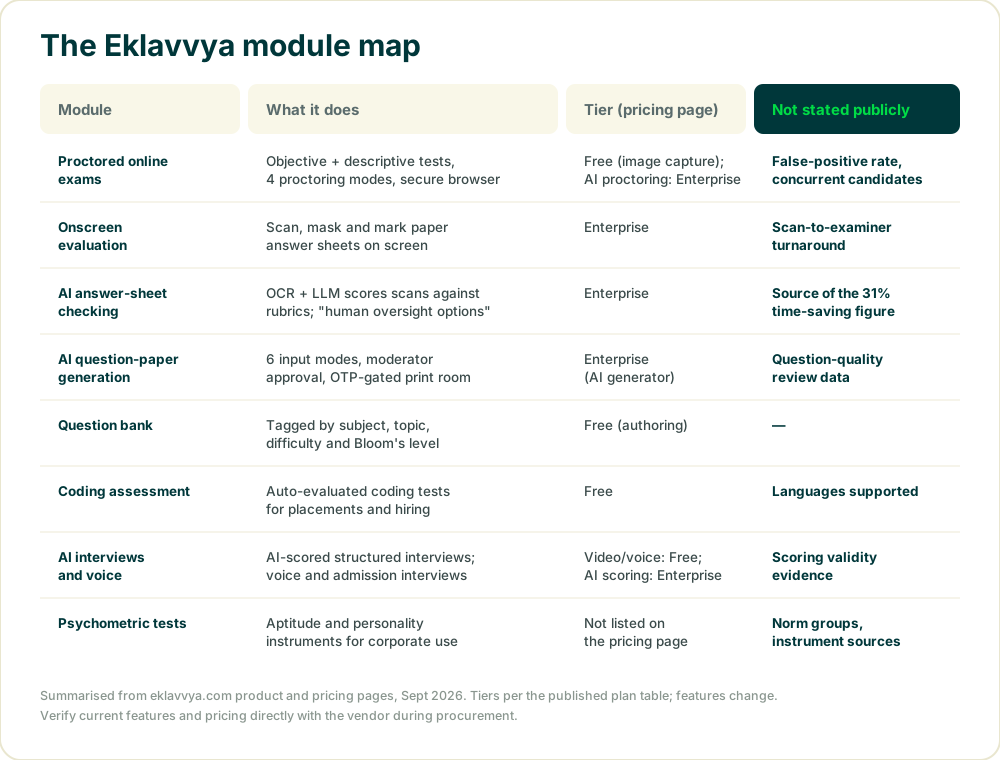
Eklavvya's navigation lists more than twenty product pages; grouped by what an exam office would buy, they collapse into eight modules.
Proctored online exams. The core product. Exams support question and option shuffling, negative marking, per-question timers, an interface in English, Hindi, French, Spanish or Arabic, an on-screen calculator, document upload during the test, and a switch to block attempts on mobile phones. Proctoring runs in four modes: image proctoring (photographs every 30–45 seconds or so, aimed at low-bandwidth regions), video proctoring (continuous streaming with live chat, pause and resume, and a human proctor checking the room), auto proctoring (continuous AI analysis for face match, extra faces and reference material), and candidate ID verification (an ID card held to the webcam for proctor approval). A 360-degree mode adds room views from a second device, and a secure browser locks the session down. Its AI proctoring page says the system "works on internet speed of as low as 0.1 MBPS"; the homepage adds detection of phones, smartwatches and earbuds in frame, and ChatGPT use flagged through typing-pattern analysis.
Onscreen evaluation. Its most established product for universities, and the subject of most of its education case studies. Paper answer sheets are scanned and masked, then distributed to examiners who mark them from anywhere, with automatic totals, moderation, re-evaluation workflows and audit logs. The product page quotes "4 to 6 mins time for evaluating each answer sheet" and result processing "over 80%" faster.
AI answer-sheet checking and AI descriptive evaluation. The newer layer on top of onscreen marking. Scanned handwriting is transcribed by OCR, then a "domain-tuned large language model" scores each answer against rubrics, model solutions and historical marking patterns, with four strictness modes and "human oversight options". The page cites unnamed "independent research" for a 31% reduction in grading time per response. We could not trace that research, so treat the figure as Eklavvya's own.
AI question-paper generation. Six generation modes (from a subject and topic, a paragraph, a syllabus PDF, last year's paper pattern, a lecture recording, or a textbook), moderator approval, branded PDF export, English plus Hindi and Marathi papers, and an "OTP-gated print room" for centres that still print.
The rest. A question bank tagged by subject, topic, difficulty and Bloom's level; coding assessments; AI interviews; voice assessments; psychometric tests; and centre-based exam delivery. Moodle integration and an API sit on the paid tiers.
Where Eklavvya is genuinely strong
Breadth. Few vendors in India cover proctored tests, paper-script marking, question-paper generation, coding tests and hiring interviews under one contract. One supplier for the exam office and the placement cell is a real convenience.
Onscreen marking adoption. This is where Eklavvya's evidence is thickest, by its own account. Its NMIMS case study reports more than 500,000 answer sheets evaluated by 500+ evaluators, with the result timeline cut from 40 days to 10. Its Sharda University case study reports 100,000+ answer sheets across 200+ courses and 25,000+ students. A TISS testimonial on the onscreen evaluation page speaks of "more than 100,000 answer sheets in each session", and its case-study index includes an unnamed public service commission. These are vendor-published figures, but the pattern is consistent: large paper-based universities use Eklavvya to digitise marking.
Security certifications. Eklavvya states CERT-IN certification (MeitY empanelment) and ISO/IEC 27001:2013, plus encryption at rest and in transit, role-based access with audit trails and "GDPR-compliant data handling". CERT-IN empanelment carries weight in Indian public-sector tenders.
Low-bandwidth delivery. Photographs at intervals instead of continuous video is a sensible design for weak connections, and the four modes let an exam body choose its trade-off between evidence and bandwidth.
Multilingual. Exam interfaces in five languages, papers in English alongside Hindi and Marathi, and evaluation pages that list Devanagari, Tamil, Telugu, Bengali, Kannada and Gujarati scripts. For state universities this matters a great deal.
A free tier. You can sign up and run 25 exams without speaking to sales, which makes a low-risk pilot easy.
Eklavvya pricing, as published
The pricing page lists three plans and no prices. Free covers 25 exams with objective, descriptive, coding, video and voice assessment, question authoring, scheduling, candidate image capture, email support and 1 GB of storage. Professional ("Contact Us") adds result reports, assessment analytics, API integration, custom certificates, exams in multiple languages and 10 GB. Enterprise ("Contact Us") is where the marketed features live: AI interviews, AI descriptive evaluation, the AI question-bank generator, AI image and video proctoring, 360-degree and audio proctoring, onscreen evaluation, centre-based exams, Moodle integration, the hybrid Android app, an LMS, white labelling and an account manager, with 20 GB.
Usage is metered in exam credits: 100 candidates sitting one exam consume 100 credits, so 1,000 credits cover 1,000 candidates in one exam or 500 candidates in two. The homepage FAQ separately describes per-candidate pricing, an annual subscription with unlimited exams, and enterprise licences "with SLA guarantees". None of these pages gives a rupee figure, so anyone quoting an Eklavvya price online is guessing. If AI proctoring, AI evaluation or onscreen marking is why you are looking, budget for an Enterprise conversation.
Where Eklavvya stops
The pricing page is unusually clear about what sits where, but the public pages leave gaps that matter to a university or an exam body.
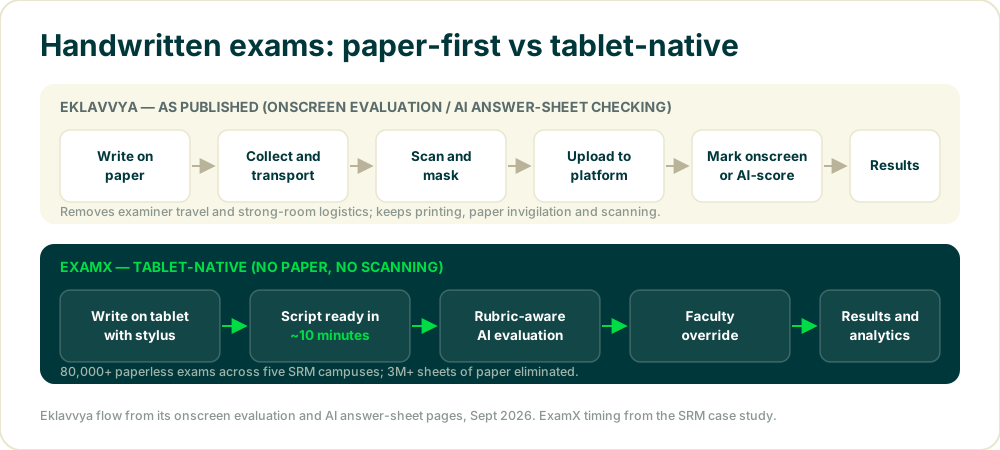
The handwritten flow still starts on paper. Onscreen evaluation and AI answer-sheet checking both begin with a scanned booklet. Students write on paper, the institution collects, scans, masks and uploads, and only then does marking, human or AI, begin. That removes examiner travel and strong-room logistics, not printing, paper invigilation or scanning, and nothing on the site describes a tablet-and-stylus mode that captures handwriting during the exam.
AI evaluation is new and Enterprise-only. It is positioned as an upgrade to onscreen evaluation, gated to the top tier, and its headline time saving cites research the page does not name.
The accuracy figure is self-reported and one-sided. "99.96% accuracy" appears across the site without a definition, a test set or a false-positive rate — the number that decides how many innocent students get flagged in a 10,000-candidate sitting.
Scale is described, not quantified. The homepage FAQ states a 99.9% uptime SLA and says the cloud "auto-scales to handle concurrent exam loads", but publishes no concurrent-candidate figure.
Not stated anywhere we could find: SOC 2, an offline exam mode that survives a dropped connection mid-paper, or how a flagged incident is reviewed before a candidate is penalised. Its review-site rating badges are unattributed and not repeated here.
What to ask Eklavvya in a demo
- How is the 99.96% accuracy measured, on which dataset, and what is the false-positive rate at our exam volume?
- Who reviews a proctoring flag, how long does that take for 10,000 candidates, and what does a student see when they contest one?
- What is the largest concurrent sitting you have delivered, and which SLA terms apply to the exam window itself?
- For onscreen evaluation, who scans and masks, and how long from the last booklet collected to the first script in an examiner's queue?
- Is AI descriptive evaluation available to us, on which tier, and can an examiner override a score with an audit trail?
- What happens to a candidate's paper if the connection drops for ten minutes mid-exam?
- Which compliance documents can you share: the CERT-IN certificate, the ISO 27001 scope, and any SOC 2 report?
- What does Enterprise cost for our candidate volume in exam credits, and what is the annual-subscription equivalent?
Vague answers to questions one, three and six should change a shortlist.
How ExamX differs
ExamX is built exam-first rather than assessment-broad, and the difference shows most in the descriptive paper. Students write handwritten answers, diagrams and equations on tablets with a stylus during the exam itself, so there is no paper, no scanning and no masking step, and scripts reach evaluators the moment the sitting ends. Rubric-aware AI evaluates subjective and essay answers, with faculty holding the final override. AI proctoring publishes both halves of the accuracy question, 99.2% detection accuracy and under 0.1% false positives, and every flag is reviewed by a human before anything happens to a candidate. Delivery runs on web, iPad and Android with a lockdown environment and an offline mode, at 100,000+ concurrent candidates with a 99.9% uptime SLA and SOC 2, ISO 27001 and GDPR compliance.
The proof point is the SRM case study: 80,000+ paperless exams across five campuses on roughly 2,000 tablets, scripts ready to evaluate in about ten minutes instead of a week, 45 days of continuous operation with zero disruptions, and 3M+ sheets of paper eliminated.
ExamX has gaps of its own, and they map onto Eklavvya's strengths. It does not offer AI interviews, psychometric instruments or a placement-style coding-test bank, and it has no live human proctor option; its proctoring is fully automated. If your placement cell is the buyer, Eklavvya's corporate modules will count for more than ExamX's exam depth. For a feature-by-feature view see ExamX vs Eklavvya; for the longer head-to-head, Eklavvya vs ExamX; and for the wider field, our guide to online exam software in India.
Eklavvya: frequently asked questions
Is Eklavvya good for university exams?
For objective online exams and for digitising the marking of paper answer sheets, its own case studies suggest it is well established in Indian universities. Its published limits: handwritten exams still start on paper, AI evaluation is Enterprise-only, and no false-positive rate or concurrency figure is published.
What is Eklavvya onscreen evaluation?
Digital marking of scanned paper answer sheets: scan and mask, distribute to examiners, mark on screen, with automatic totals, moderation, re-evaluation and audit logs. Eklavvya states 4 to 6 minutes per sheet and a PCT patent on the system.
How much does Eklavvya cost?
No prices are published. Free covers 25 exams; Professional and Enterprise are on request, metered in exam credits (100 candidates in one exam = 100 credits). AI proctoring, AI evaluation and onscreen evaluation are Enterprise-only.
Is Eklavvya's AI proctoring accurate?
Eklavvya states 99.96% accuracy. The figure is self-reported, with no definition or false-positive rate published. Ask for both. ExamX publishes 99.2% detection accuracy with under 0.1% false positives.
What are the best Eklavvya alternatives?
ExamX for exam-first, paperless descriptive exams; Mercer | Mettl for hiring psychometrics and coding; CodeTantra for an LMS-first platform with coding labs.
Eklavvya vs ExamX: which fits descriptive exams better?
Eklavvya is paper first (write, scan, mark). ExamX is tablet native (write on tablet, AI-evaluated with faculty override, scripts ready in about ten minutes at SRM). Keep paper and speed up marking: Eklavvya. Stop printing and scanning: ExamX.
The bottom line
Eklavvya is a credible, broad platform with a strong record, by its own account, in one specific job: making the marking of paper answer sheets faster and more accountable. If that is your problem, it belongs on your shortlist, and its free tier makes a pilot cheap. If your problem is the paper itself — the printing, the invigilation, the scanning, the week between the last exam and the first marked script — a marking tool solves the wrong half of the workflow.
ExamX was built for that second problem. Book a demo and bring your longest descriptive paper; we will run it paperless, end to end, in front of you.
Eklavvya capabilities and pricing tiers summarised from its public pages, September 2026. Verify current features and pricing directly with the vendor during procurement.