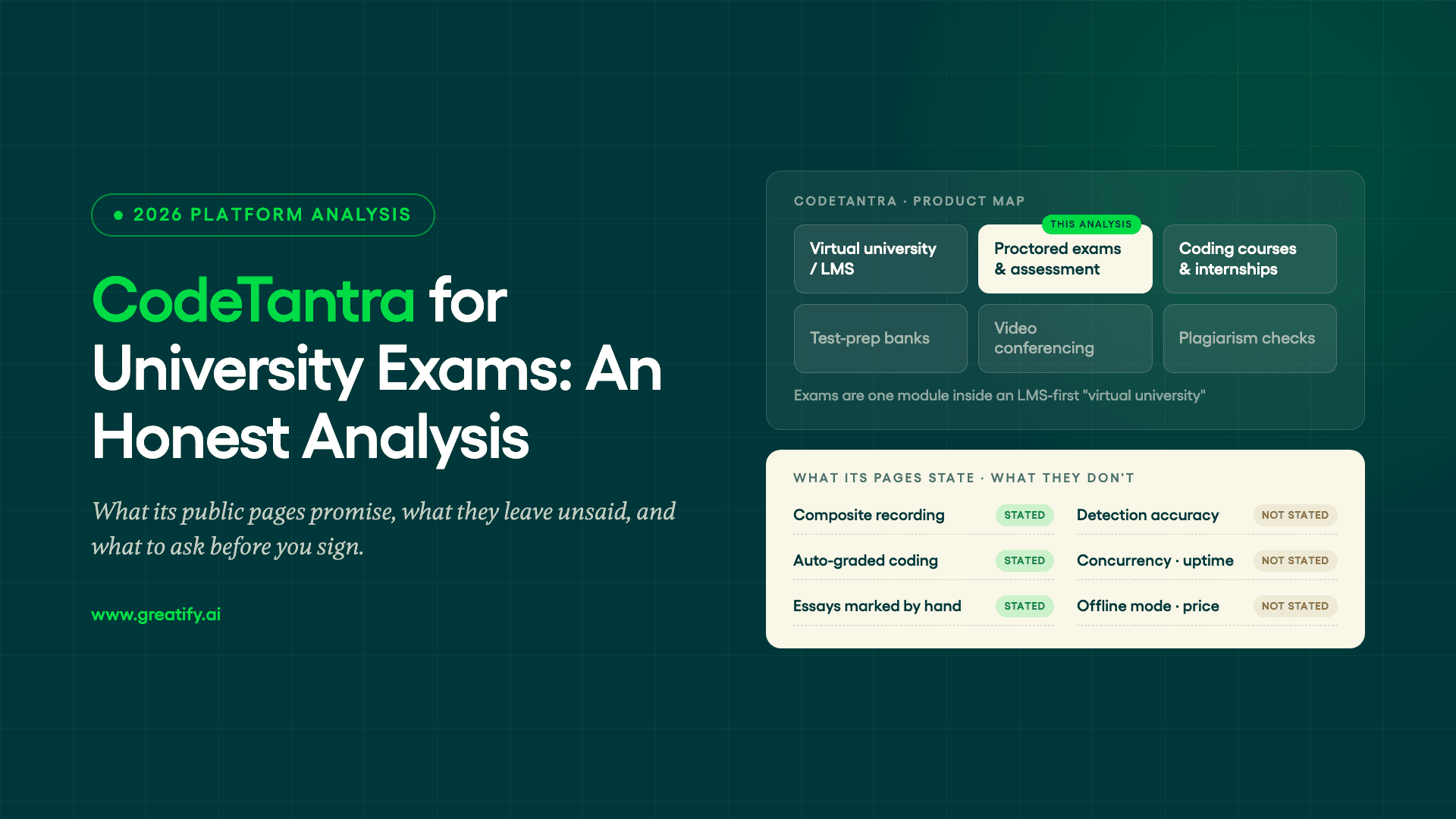
CodeTantra turns up on almost every Indian university's exam-platform shortlist, often for a reason that has little to do with exams: the engineering departments already teach on it. Once the coding labs and live classes live in one system, running proctored exams there too looks like the path of least resistance. This analysis asks whether that instinct holds up. It is based on CodeTantra's public product pages, its app listing and two university notices as of September 2026, not on hands-on testing, and we build a competing product, so read it as an informed outside view rather than a verdict. If you want the two-minute version, our ExamX vs CodeTantra page has it. This is the long one.
What CodeTantra is, and who builds it
CodeTantra Tech Solutions is a Hyderabad company, founded in 2014 and recognised under Startup India. Its about page is candid about its origin: the aim was "inculcating software coding skills among youth", the platform began as an interactive way to learn programming, and the first customer arrived in 2018. The founders are Ramana Telidevara (Founder and CEO, who earlier co-founded TalentSprint) and Ravi Sekhar Chilmakuri (Founder and CTO), batchmates from BITS Pilani.
The credential the company leads with is that its teaching and learning platform was "selected by the Ministry for Human Resources Development (MHRD) and AICTE as one of a handful of EdTech companies" after what it calls a rigorous evaluation. That is CodeTantra's statement on its own page; treat it as evidence of government exposure rather than a certification of the exam product.
What started as a coding-practice tool is now sold under the tagline "Your virtual university, in minutes!": online classes, assessments, proctored exams, assignments, auto-grading and plagiarism checks in one platform. Exams are one module inside that bundle. That single fact explains most of what follows.
The five product lines
CodeTantra's about page lists its products in this order, and the order shows where the company's centre of gravity sits.
- Virtual university / LMS. In its own phrase "a Learning Management System on steroids": data isolation between schools, curriculum management, course authoring, timed assignments, a "secure digital vault for question banks", timetabled live classes and fee payments.
- Testing and assessment with remote proctoring. The module universities mean when they say "CodeTantra exams". It gets its own section below.
- Interactive online courses and internships. Hands-on courses in Python, Java, C and C++, data structures, machine learning, IoT and English, plus instructor-led internships with projects.
- Test-prep question banks. Tens of thousands of questions, by its count, across campus placements, GATE, TOEFL, GRE, ACT, SAT and GMAT.
- Video conferencing built for teaching. The newest line: browser-based, tuned for low bandwidth, with breakout rooms, cloud recordings and a second-device mode for chalkboard teaching.
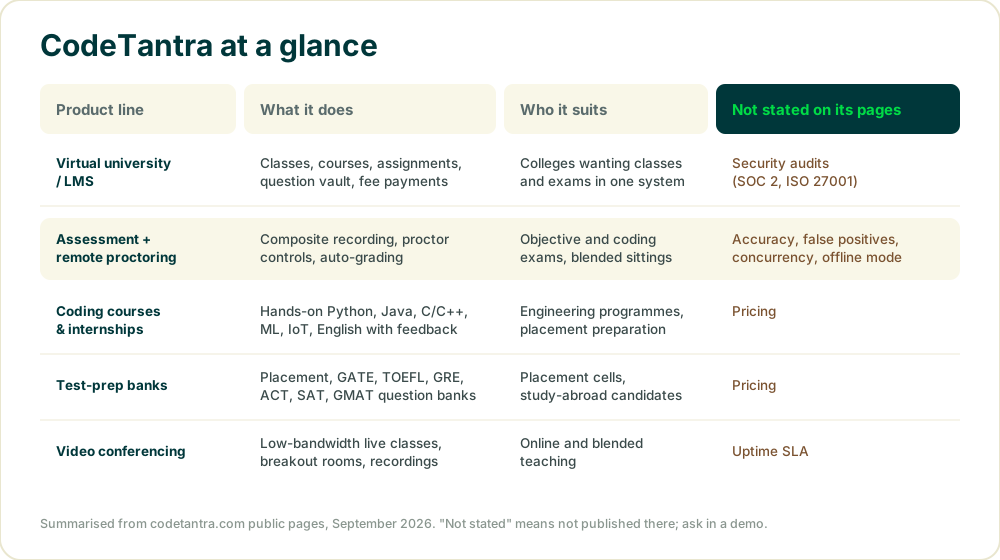
Notice what is absent: a standalone examination product. Assessment is line two of five, and the company describes itself through the LMS first.
How CodeTantra's proctored exams work
The homepage calls the exam module an "AI assisted Assessment Platform with Online Remote Proctoring" and pitches it for "uncontrollable test-taker environments", which is an honest way to describe a student's bedroom. Its published mechanics fall into four groups.
Access and security. Two-factor authentication, role-based access control, and encryption over the wire and at rest, with complete data isolation by domain.
Recording and proctor control. The distinctive claim is "composite recording and playback of all aspects of a test": multiple cameras, the screen, timings, navigation, locations, answers and multiple audio streams, replayable together afterwards. The system automatically blocks bad actors, and a human proctor keeps "complete control" to extend or terminate a test. The Android app listing adds the student side: "AI proctored, AI assisted, human proctored, and non-proctored exams", an SOS request, live help over audio, video or chat at very low bandwidth, and blended-mode exams where some students sit in a hall and others sit remotely.
Question types and grading. CodeTantra says it offers "over 200 knobs" to design and schedule tests. Auto-evaluated types: programming in multiple languages, variants of multiple choice, fill in the blanks, numerical answers, match the columns, spoken English, and reading and listening comprehension. Manually evaluated types: subjective essays, viva voce and document uploads. The app listing also mentions scanned handwritten questions, short and long answers, formula and LaTeX input, and voice-answered questions.
Administration. Bulk question-bank import is automatic for standardised templates and handled manually, as premium support, for ad-hoc formats. Evaluation audit trails, plagiarism reports and consolidated reports for accreditation round it out.
This is a competent proctored-exam engine for objective and coding assessments, with unusually detailed session recording. The two words to underline are "manually evaluated". For a B.Tech programme where most marks come from code and MCQs, that is a footnote. For a commerce, arts or law faculty where most marks come from long answers, it is the whole story.
Who uses CodeTantra
The homepage shows customer logos it calls "a small subset of our customers": IIT Kanpur, IIT Madras, IIT Guwahati, IIT Bombay and IIT Tirupati; IISER Pune and IISER Tirupati; IIIT Bangalore, IIIT Guwahati, IIIT Kota and IIIT-DM Kurnool; Christ, Bennett, GITAM, Chandigarh, Alliance, CMR and Ashoka universities; and a long tail of engineering colleges. Two universities have said in public how they used it. Lovely Professional University announced in September 2020 that mid-term examinations would run on CodeTantra, and SASTRA University published a student manual for proctored exams on the CodeTantra Virtual University platform in May 2021.
Both notices date from the remote-exam period, when many Indian universities first met the platform. Whether they still run end-semester exams on it in 2026 is not something the public record answers; it is a fair question for a reference customer.
Where CodeTantra is genuinely strong
Engineering programmes. Auto-graded programming in multiple languages, coding courses students practise on all semester, and exams that use the same question engine. If your marks are mostly code, CodeTantra grades them without a human in the loop, and that practice-to-exam continuity is something an exam-only platform cannot offer.
One platform for classes and exams. A college that wants an LMS, a live-class tool and a proctored-exam module in one contract gets exactly that: fewer vendors, one student login, one timetable. Our buyer's shortlist for universities argues that stack size matters as much as any feature, and CodeTantra shrinks it for institutions that need the teaching half too.
Proctor control and low-bandwidth design. Composite replay of cameras, screen and audio gives an exam controller real evidence when a case is contested, and the power to extend or terminate a session is the right control to have. The app promises help "at extreme low bandwidth usage" during a test, which matters more in a Tier-2 hostel than any feature list.
We will not claim anything about price: CodeTantra publishes no rates, and any statement about cost would be a guess.
Where the public pages stop
Every gap below is a gap in what CodeTantra states, not necessarily in what it can do. That is the limit of a public-information analysis, and why the next section is a checklist rather than a scorecard.
- Descriptive answers are marked by hand. "Subjective essay" sits in the manually evaluated column, and nothing describes AI evaluation of long answers. At semester scale that is the same marking backlog you have on paper, on a screen.
- Handwriting means scanning. The app lists "scanned handwritten type questions". Nothing describes writing natively on a tablet with a stylus, so a handwritten exam still involves paper, a camera and an upload.
- No performance numbers. No published proctoring detection accuracy, false-positive rate, peak concurrency or uptime SLA. "Unlimited test support" on the homepage is a licensing statement, not a load figure.
- No named certifications. Encryption in transit and at rest is stated; SOC 2, ISO 27001 or equivalent audits are not listed anywhere we could find.
- No stated offline mode. Low-bandwidth design is real, but a mid-exam loss of connection altogether is not addressed.
- LMS-first packaging. The pages do not say whether the assessment module is sold alone or only inside the virtual university.
What to ask CodeTantra in a demo
Bring the hardest exam you run to the demo, not the easiest. These eight questions cover every blank above.
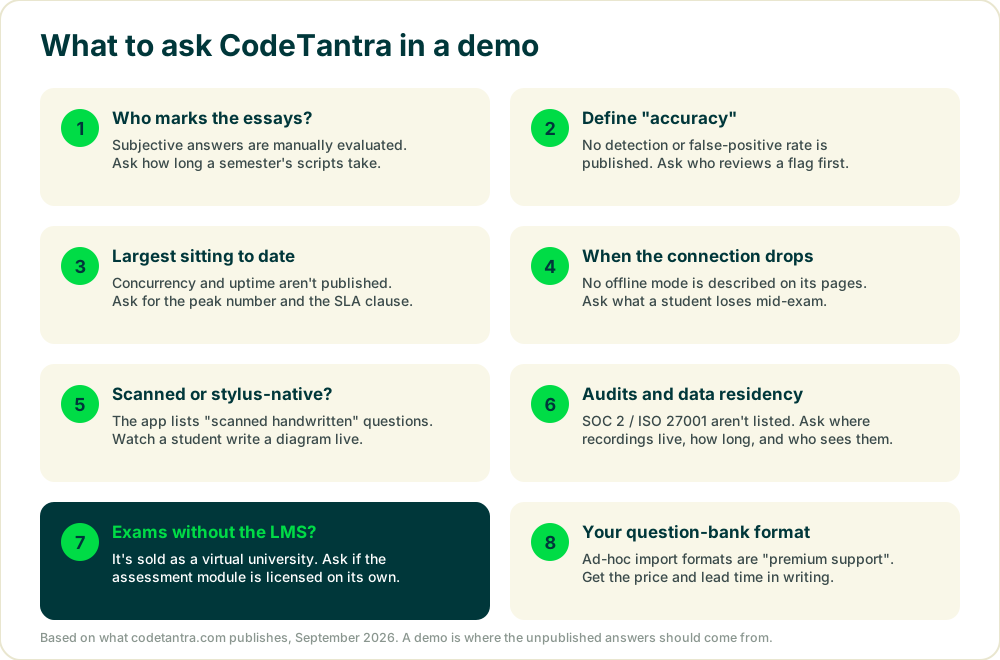
- Who marks the essays, and how long does a semester's worth take? Ask for a realistic turnaround at your script volume.
- Define "accuracy". What counts as a detection, the false-positive rate on a real cohort, and who reviews a flag.
- Largest simultaneous sitting to date, and the uptime clause in the contract. "Unlimited" is a licence term, not a number.
- What happens when the connection drops entirely mid-exam? Lost answers, lost time, or a clean resume?
- Handwritten answers: scanned upload or stylus-native? Watch a student write a diagram live.
- Which audits, and where does data live? SOC 2, ISO 27001, residency, retention of recordings, and who can see them.
- Can we buy the assessment module without the LMS? And what you lose if you do.
- What does importing our question-bank format cost? Ad-hoc formats are "premium support". Get price and lead time in writing.
How ExamX differs, and where it does not compete
The cleanest way to place ExamX by Greatify next to CodeTantra is by what each was built around. CodeTantra was built around teaching and grew an exam module. ExamX was built around the examination and never grew a classroom.
That shows up first in descriptive exams. On ExamX, students write long answers, diagrams and working on tablets with a stylus, and rubric-aware AI evaluates the script with faculty holding the final override; there is no scan-and-upload step and no manual marking queue by default. It shows up second in what is published: AI proctoring at 99.2% detection accuracy with under 0.1% false positives, flags reviewed by humans with no automatic penalties, 100,000+ concurrent candidates, a 99.9% uptime SLA, offline mode on web, iPad and Android, and SOC 2, ISO 27001 and GDPR compliance. Those are the figures CodeTantra's pages leave blank, and you should make us define them in a demo too.
The proof point is SRM Institute of Science and Technology: 80,000+ fully paperless exams across five campuses on roughly 2,000 tablets, scripts ready for evaluation about 10 minutes after each exam instead of about a week on paper, 45 continuous exam days with a peak of around 1,800 concurrent candidates and zero disruptions. The SRM case study has the full account; our online exam software for India page covers the wider rollout model.
Now the other side of the ledger, stated as plainly as CodeTantra's. ExamX has no coding labs, no LMS and no live classes. If your engineering faculty want students to practise Python all semester and then sit an auto-graded coding exam in the same tool, CodeTantra does that and ExamX does not. ExamX also has no live human proctor tier, and, like CodeTantra, it prices on request. The feature-by-feature account is in our CodeTantra vs ExamX comparison; a university with both an engineering school and a descriptive-heavy faculty may reasonably run both.
CodeTantra: frequently asked questions
Is CodeTantra good for online exams?
For objective and coding exams inside an institution that already teaches on it, yes. Its pages list essays as manually evaluated and publish no accuracy, concurrency or uptime figures, so descriptive-heavy universities should test those in a demo.
Does CodeTantra have AI proctoring?
Yes. The homepage describes an AI-assisted assessment platform with remote proctoring, and the app offers AI-proctored, human-proctored and non-proctored exams. No detection accuracy or false-positive rate is published.
What question types does CodeTantra support?
Auto-evaluated: programming, MCQ variants, fill in the blanks, numerical, match columns, spoken English, comprehension. Manually evaluated: subjective essay, viva voce, document upload. The app adds scanned handwritten, long answer, LaTeX and voice questions.
Which universities use CodeTantra?
Its homepage lists IIT Kanpur, IIT Madras, IIT Guwahati, IIT Bombay, IISER Pune and Tirupati, several IIITs, Christ, Bennett, GITAM, Chandigarh, Alliance, CMR and Ashoka among "a small subset" of customers; LPU (2020) and SASTRA (2021) have published notices about proctored exams on it.
What is the CodeTantra alternative for descriptive exams?
ExamX: tablet-native handwritten answers evaluated by rubric-aware AI with faculty override, published proctoring accuracy, offline delivery and SRM-scale proof. It does not offer coding labs, an LMS or live classes.
Does CodeTantra publish pricing?
No. The site routes buyers to a sales enquiry, as most institutional exam platforms do, ExamX included.
The bottom line
CodeTantra is a serious teaching platform with a capable exam module attached, and for an engineering college that wants labs, classes and coding exams in one contract, that is a strong offer. The questions start where the marks stop being auto-gradable. If most of your marks come from long handwritten answers, or exam week puts tens of thousands of students online at once, what you most need to know is what CodeTantra's pages do not say, and the checklist above is how to get it. To see the exam-first alternative run your hardest descriptive paper end to end, Book a demo and bring that paper with you.
CodeTantra capabilities summarised from its public pages, September 2026. Verify current features and pricing directly with the vendor during procurement.