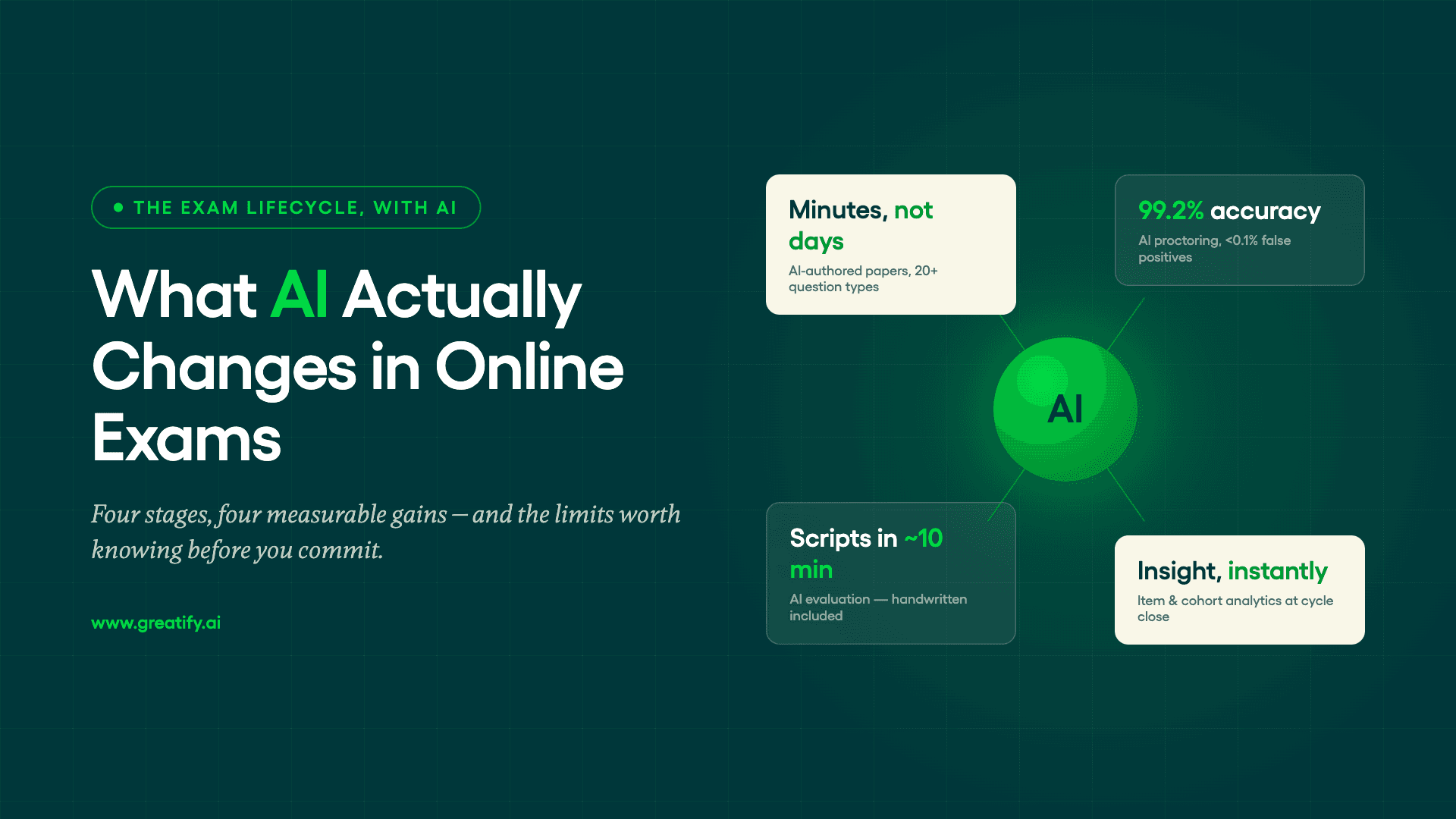
The argument about whether AI belongs in examinations ended quietly, and the students settled it: 88% of UK students now use generative AI in their assessment work, up from 53% a year earlier, per the HEPI/Kortext Student Generative AI Survey 2025. AI is already in your exams. The only open question is whether it is also working for the institution — authoring the papers, protecting their integrity, marking the scripts — or only for the people trying to game them.
This article is the institutional side of that ledger: what AI measurably changes across an online exam's lifecycle, with real deployment numbers, and the limits your evaluation should respect.
Where AI works in an exam — the map
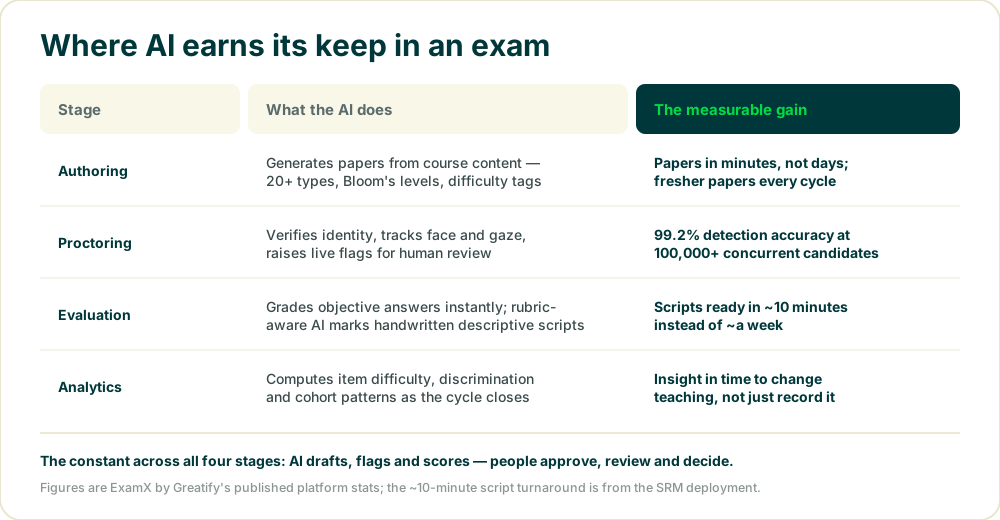
An examination has four stages where effort concentrates: writing the paper, supervising the sitting, marking the answers, and understanding the results. AI now earns its keep at every one of them — differently at each.
Benefit one: papers in minutes, and fresher every cycle
Hand-writing a balanced exam paper takes a subject-matter expert days; an item bank takes a semester. AI question authoring collapses the drafting: generate from your actual course content across 20+ question types with Bloom's-taxonomy coverage, then have faculty review, edit and approve every item before it can reach a paper. The speed matters, but the second-order benefit matters more — when a fresh paper costs minutes instead of days, you stop recycling last year's questions, and recycled questions are a growing integrity risk in the era of that 88% statistic. India's UGC has pushed the same direction for years, calling question-bank-based paper setting "a much needed reform".
There is also a compounding effect the speed argument misses: every approved item joins a moderated, tagged question bank, so the institution accumulates an assessment asset instead of a folder of expired Word documents. Next semester's paper starts from hundreds of reviewed items with known difficulty tags; randomised variants come from the bank rather than from an all-nighter; and a leaked paper costs one draw from the bank, not the cycle. We covered this stage in depth in AI question authoring, explained.
Benefit two: integrity that scales to exam week
Human invigilation scales with staffing; AI proctoring scales with infrastructure. ExamX's AI proctoring verifies identity with a face match, then tracks face, gaze and device activity through the session, raising live flags — at 99.2% detection accuracy with under 0.1% false positives, across up to 100,000+ concurrent candidates. That last number is the operational point: exam week means everyone writes at once, and an integrity model that needs one human per room, or one scheduled remote proctor per candidate, meets its ceiling exactly when you need it most.
The fairness of the model lives in what happens after a flag: in ExamX, flagged moments go to human reviewers with evidence. Nobody fails an exam because an algorithm disliked a glance out the window — a design principle worth demanding from any vendor, as we argue in the plain-English proctoring guide.
Benefit three: marking in minutes — including handwriting
Evaluation is where most institutions bleed the most time, and where most exam tools quietly give up: they auto-grade multiple choice and hand the essays back to faculty. The harder problem is the real one. In ExamX, students write full handwritten descriptive answers, diagrams and equations on tablets with a stylus, and rubric-aware AI evaluates them against the marking scheme with faculty override on the final mark. At SRM, answer scripts were ready for evaluation within about 10 minutes of an exam ending — against roughly a week under the paper process.
Benefit four: analytics that arrive in time to matter
A paper cycle produces marks; an AI cycle produces understanding. Item difficulty, discrimination, topic-level and cohort patterns land the moment a cycle closes, and the timing is the entire point. A question that confused a whole cohort gets caught — and can be excluded or re-weighted — before results publish, not discovered in a complaint afterwards. A topic that half the intake missed is visible while the teaching plan for next semester is still a draft. Exam committees walk into moderation meetings with evidence instead of anecdotes, and accreditation reviews start from exportable item statistics rather than a scramble through spreadsheets.
The same data quietly improves the exams themselves: items that discriminate well earn their place in the bank, weak ones get flagged for revision, and difficulty drift across years becomes something you can see rather than suspect. Insight that arrives months later is a record; insight that arrives the same day is a decision.
The compounding benefit: the cycle itself gets cheaper
Each gain above is useful alone; together they change the economics of examining. SRM Institute of Science & Technology ran its MBA and M.Tech examinations fully on ExamX — 80,000+ paperless exams across five campuses on roughly 2,000 tablets — and the before/after reads like different industries:
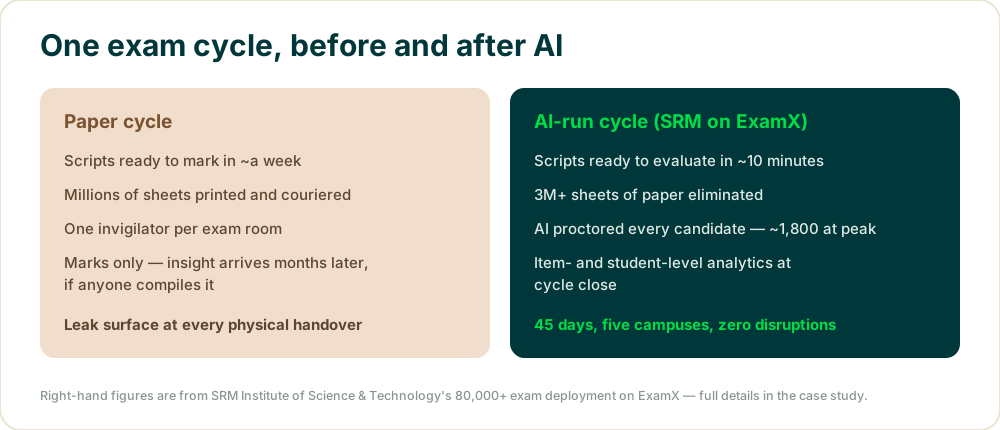
The full account — including the 45 days of continuous operation with zero disruptions — is in the SRM case study.
Not just universities
The same four gains transfer wherever results carry consequences. Government recruitment bodies get national-scale concurrency with a defensible integrity record and no paper to leak between centres. Certification programmes get fresh papers per sitting from the bank and same-day scoring for candidates who paid for a result, not a waiting period. Enterprises get compliance assessments that audit cleanly, because every flag, review and mark leaves a trail. The stakes differ; the lifecycle — author, deliver, proctor, evaluate, analyse — is the same machine.
The honest limits
A credible case for AI in exams includes what it does not do. AI does not exercise academic judgment — it drafts, flags and scores, while faculty approve papers, review flags and hold the override on marks; an institution that removes those humans is misusing the tool. AI proctoring is not a fraud guarantee — it is a detection rate and a false-positive rate, and vendors who publish neither deserve your scepticism, including on comparison pages like ours. Accommodation needs care: students with disabilities and non-standard environments must be configured for, not flagged. And automated proctoring does not satisfy the handful of licensure contexts that mandate a live human proctor with intervention authority — for that requirement, a service like ProctorU fits, as we cover honestly in the platform comparison.
Adopting AI without losing trust
The technology is the easy half of adoption; the trust is the half that decides whether it sticks. Three practices separate the deployments that students and faculty accept from the ones they resent.
Tell students exactly what the AI watches. Publish what is monitored (face, gaze, device activity), what is not, what triggers a flag and who reviews it. Proctoring that feels like surveillance breeds the adversarial exam experience accreditors warn about; proctoring that is explained reads as fairness — the honest students are the ones it protects.
Give every flag a human path. An appeal process is not an admission the AI is weak; it is what makes the AI usable. Reviewers see the flagged moment with evidence, the student can contest it, and the record shows a person made the call. The same logic applies to marking: faculty override on AI-evaluated scripts is what lets examiners sign the results with their own names.
Treat the first cycle as calibration. Faculty trust AI evaluation when they watch it agree with them. Run the first full cycle with evaluators comparing the AI's rubric-based marks against their own judgment before leaning on it — SRM's first cycle covered 80,000+ exams exactly this way, and expansion afterwards was configuration rather than persuasion.
Questions to ask any vendor about AI claims
- How do you define detection accuracy, and what is the published false-positive rate?
- What exactly happens after a flag — who reviews it, how fast, and can a student appeal?
- Can the AI evaluate our real answer formats — handwritten descriptive papers, diagrams, equations — or only typed and objective ones?
- How are rubrics calibrated to our marking schemes, and can faculty override every mark?
- Where are exam recordings and scripts stored, under which certifications, and for how long?
- How does the system behave for students with disabilities or non-standard environments?
Vendors comfortable with all six questions are describing a system; vendors who redirect to a demo are describing a hope.
AI in online exams: FAQs
What are the benefits of AI in online exams?
Papers authored in minutes with fresher content every cycle, integrity at exam-week scale (99.2% detection accuracy, 100,000+ concurrent), marking in minutes including handwritten scripts, and item-level analytics at cycle close.
How does AI prevent cheating in online exams?
Identity verification, face and gaze tracking, device monitoring and live flags — with flagged incidents reviewed by humans at under 0.1% false positives, never auto-penalised.
Can AI grade descriptive and handwritten answers?
Yes — rubric-aware AI evaluates handwritten tablet scripts with faculty override. It is the stage most tools skip and usually the biggest time saving.
Does AI replace examiners and faculty?
No. The judgment stays human — approving papers, reviewing flags, overriding marks. The queue-clearing gets automated.
Is AI proctoring fair to students?
The design decides: published false-positive rates, human review after every flag, and proper handling of accommodations. Demand all three from any vendor.
How should an institution start?
One programme, one full cycle, then expand as configuration — the pattern SRM proved with its MBA and M.Tech exams.
The bottom line
Students already brought AI to the exam. Institutions that answer with AI of their own — authoring, proctoring, evaluating, analysing on one platform — get faster cycles, fresher papers, defensible integrity and same-day insight, with humans still holding every judgment call. If you are weighing where to start, the 2026 platform shortlist maps the market, or book a demo and run your hardest exam — the handwritten one — through ExamX end to end.
Survey figure from the HEPI/Kortext Student Generative AI Survey 2025 (Policy Note 61); UGC recommendation from "Evaluation Reforms in Higher Educational Institutions" (2019). Platform figures are ExamX by Greatify's published stats; deployment numbers are from the SRM case study.