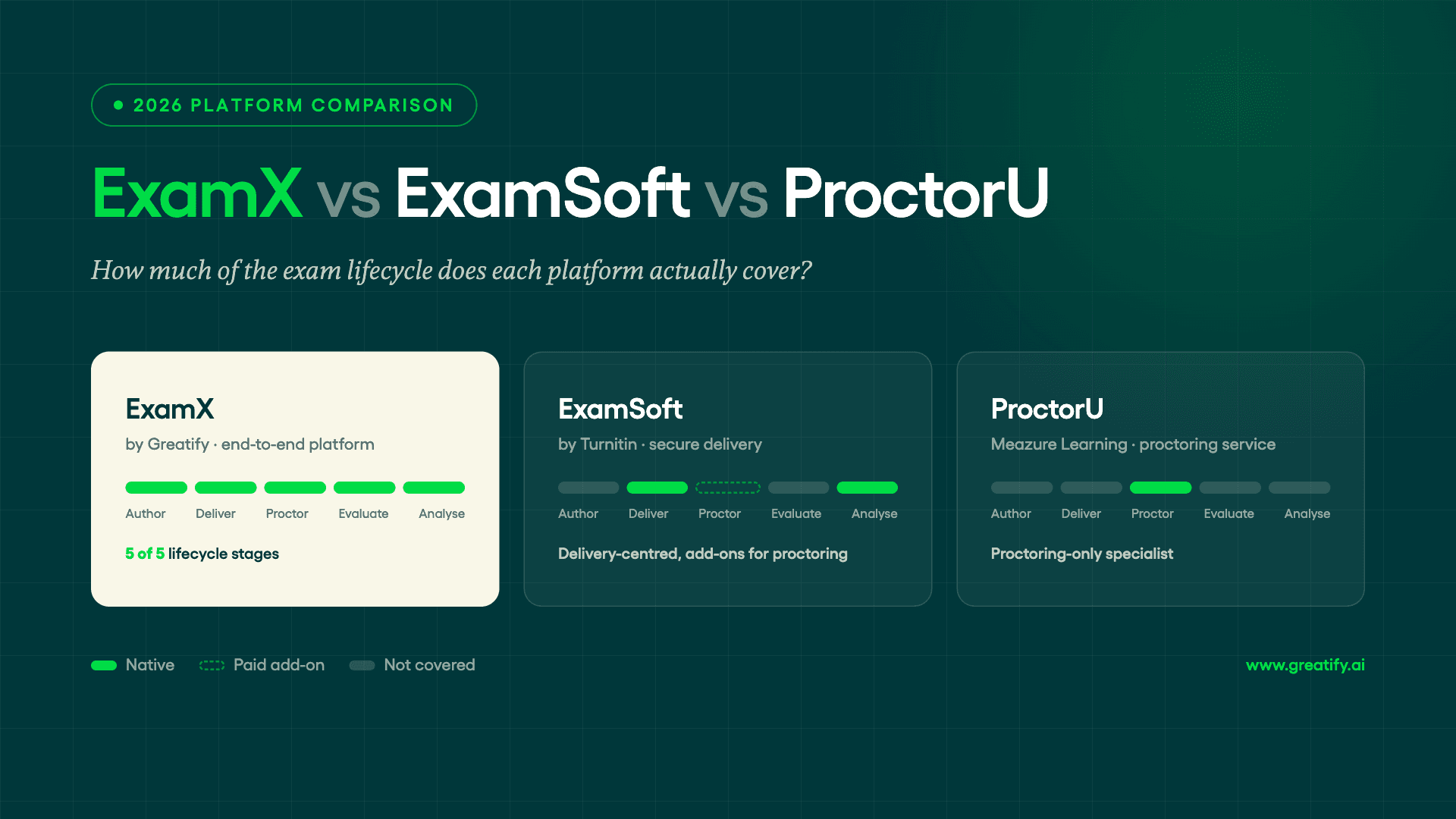
If you are evaluating online exam proctoring software in 2026, the shortlist usually collides with a familiar problem: every tool covers a different slice of the exam, and none of them covers all of it. One vendor authors questions. Another delivers the paper. A third watches candidates. Your IT team glues it together, and your administrators chase results across three dashboards.
This AI exam platform comparison looks at three names that come up constantly in institutional procurement: ExamX by Greatify, ExamSoft by Turnitin, and ProctorU, now part of Meazure Learning. All three are credible products — and they are three very different kinds of product. That difference matters more than any single feature, so we describe each one honestly, including where ExamX is not the right choice.
Three platforms, three different jobs
ExamSoft is a secure delivery product. Its job is to run a locked-down, typed exam on a student's own device, online or off. ProctorU is a proctoring service. Its job is to watch candidates sitting an exam that lives somewhere else — usually your LMS. ExamX is an end-to-end platform: it authors the paper with AI, delivers it, proctors it, evaluates the answers and reports the results, all in one system.
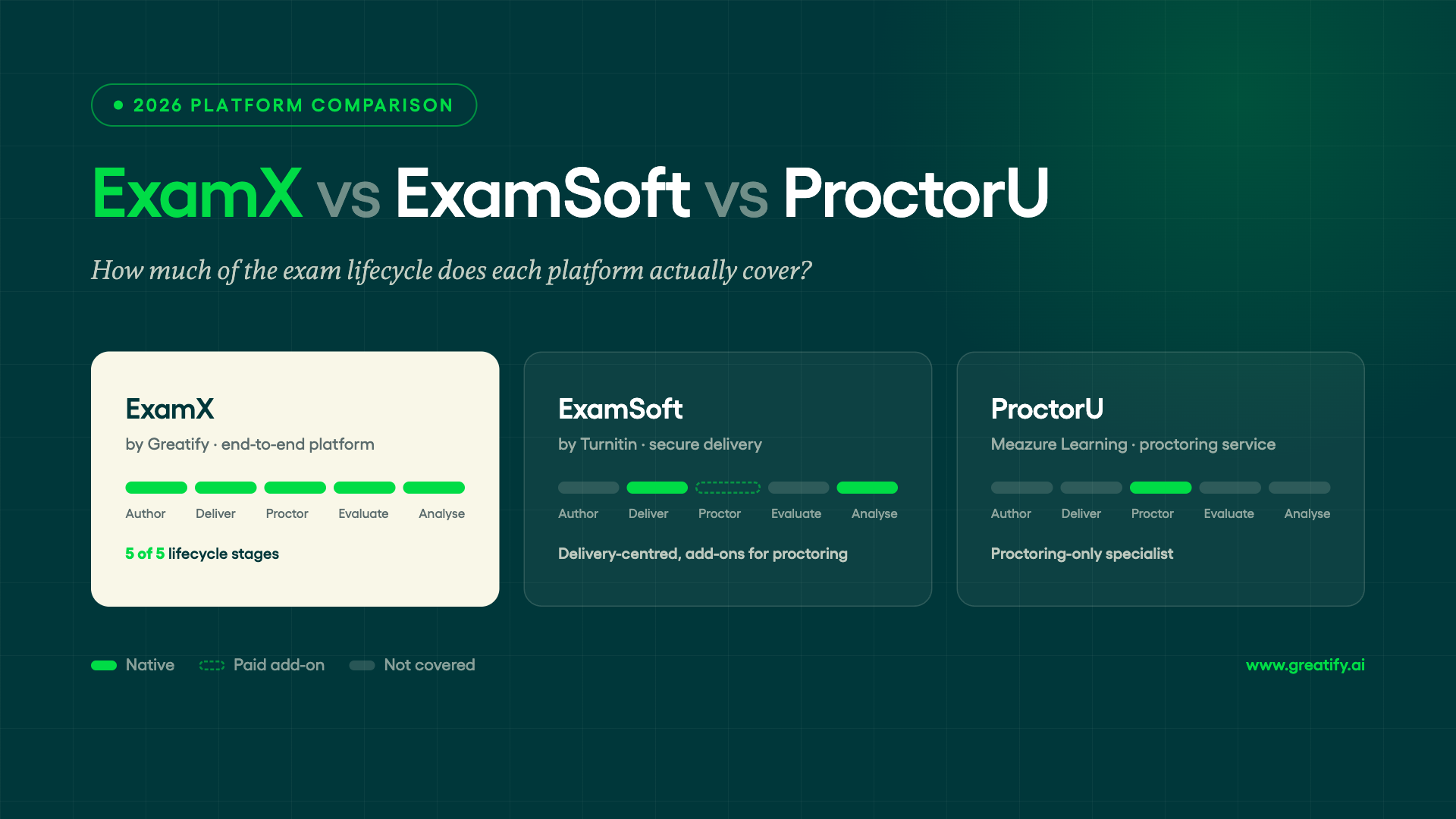
None of these is a wrong way to build a product. But it means the real question is not "which tool is best" — it is "how many tools do you want to run".
ExamSoft: secure offline delivery, with proctoring as an add-on
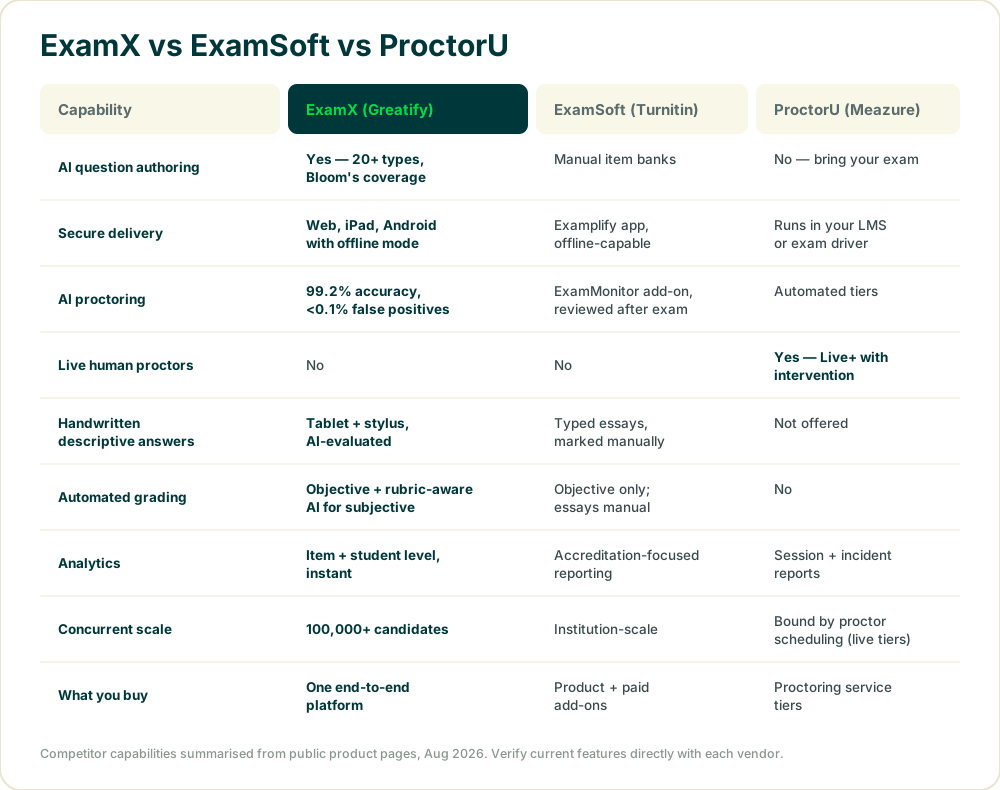
ExamSoft has been a fixture in professional education — law, medicine, nursing, pharmacy — for years, and its core strength is real: the Examplify app runs exams in a locked-down environment that blocks other applications, internet access and generative-AI tools, and keeps working when the connection drops. For typed, objective-heavy exams in bandwidth-poor rooms, that reliability is exactly what programmes buy it for. Its reporting is built around accreditation: item analysis, category tagging and longitudinal performance data.
Remote integrity comes through two optional add-ons: ExamID matches a student's photo against a baseline before the exam starts, and ExamMonitor records audio and video of the session, flags behaviour with AI and routes the flags to human reviewers after the exam ends. It is a record-and-review model — nobody intervenes while the exam is running.
Where does it stop? Question authoring is manual, built on item banks faculty maintain themselves. Essay answers are typed and marked by hand. And because proctoring is an add-on rather than the product, institutions consolidating their exam stack still end up managing several moving parts. ExamSoft solves delivery well; it was never designed to solve the whole exam.
ProctorU (Meazure Learning): proctoring as a service
ProctorU merged with psychometrics firm Yardstick in 2020 to form Meazure Learning, and its proctoring comes in service tiers that map neatly to stakes. Live+ puts a trained human proctor on the session with the authority to intervene. Review+ records everything and has professionals review each session. Record+ automates the launch and review for low-stakes tests. That range — with a live human in the loop at the top — is genuinely useful, and some accreditation and licensing contexts require exactly that.
The model's boundary is just as clear. Your exam runs in your LMS or exam driver; ProctorU secures the session around it. It does not author your questions, grade your answers or analyse your results — for a university's own exams, all of that stays wherever it already lives. (Meazure does build exams as a service for credentialing bodies, but that is consultancy for certification programmes, not a platform your faculty use.) So adding ProctorU adds a vendor rather than replacing one. And live human proctoring has economics to respect: every session needs a scheduled proctor, which is manageable for hundreds of candidates and a very different conversation for tens of thousands sitting simultaneously.
ExamX: the whole exam lifecycle on one platform
ExamX starts from the opposite premise: an institution should not need four products to run one exam. Faculty generate question papers with AI from any content — 20+ question types with full Bloom's-taxonomy coverage — instead of maintaining item banks by hand. Exams run on web, iPad and Android with a lockdown environment and offline support, so a dropped connection never ends an exam. AI proctoring verifies identity, tracks face and gaze, and raises live alerts at 99.2% detection accuracy with under 0.1% false positives, at up to 100,000+ concurrent sessions — exam integrity software built for universities running everyone-at-once exam weeks, not one-at-a-time appointments.
Then comes the stage neither ExamSoft nor ProctorU touches: evaluation. Students write full handwritten descriptive answers on tablets with a stylus, and rubric-aware AI evaluates them — subjective and essay answers included — with faculty holding the final override. Objective questions grade instantly. Item-level and student-level analytics land the moment a cycle closes. The platform carries SOC 2, ISO 27001 and GDPR compliance with a 99.9% uptime SLA.
This is not hypothetical scale. SRM Institute of Science & Technology ran 80,000+ fully paperless exams across five campuses on ExamX — roughly 2,000 tablets, answer scripts ready to evaluate within 10 minutes of each exam ending, zero disruptions across 45 days. The full numbers are in the SRM case study.
Which platform fits your institution?
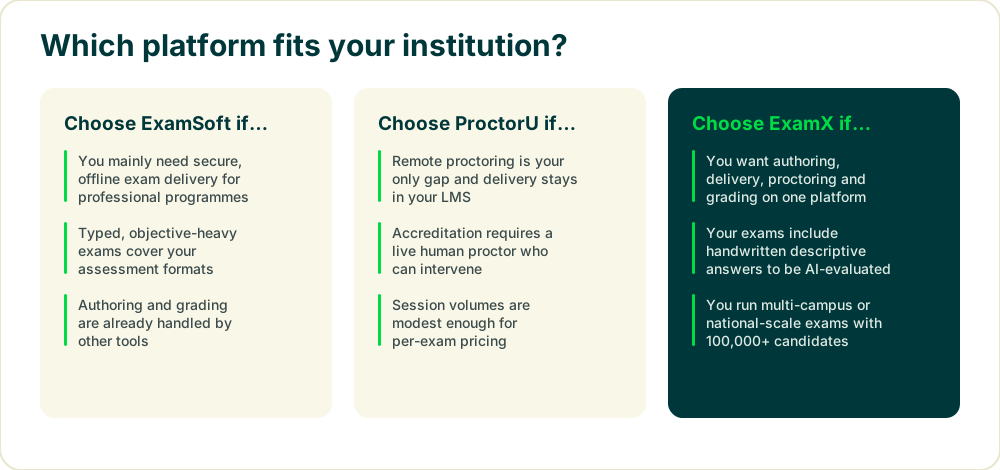
Choose ExamSoft if your exams are typed and objective-heavy, secure offline delivery is the main requirement, and authoring and grading are already covered elsewhere. Its long record in law and medical programmes makes faculty adoption easier in those settings.
Choose ProctorU if remote proctoring is your only gap and your delivery stack is staying put — especially if accreditation requires a live human proctor with the authority to intervene. That is a real requirement in some licensing contexts, and it is something ExamX deliberately does not offer.
Choose ExamX if you are consolidating. If separate systems currently handle authoring, delivery, proctoring and grading — or if your exams include handwritten descriptive papers that today take weeks to mark — ExamX replaces that stack with one platform, and the gains compound at multi-campus and national scale.
The cost that matters is the stack, not the licence
None of the three vendors publishes pricing, so any sticker comparison is guesswork. Total cost of ownership is not. Three tools means three contracts, three integrations someone has to own, three compliance reviews and three support lines to call when something breaks the night before finals. Administrators lose time switching dashboards; IT loses time keeping data flowing between systems that were never designed to talk to each other.
That overhead is the honest case for consolidation — and the honest caveat is that consolidation only pays if the single platform genuinely covers your formats and your scale. Which is why the evaluation questions below matter more than any feature list, ours included.
How to read AI proctoring accuracy claims
Every vendor in this space quotes an accuracy number, and the numbers are not comparable unless you know what they measure. "Detection accuracy" can mean the share of genuine violations caught, the share of flags that turn out to be real, or a blend of both — and the difference decides how much work lands on your staff. A system tuned to flag aggressively will catch more, but if its false-positive rate is high, every exam week produces a mountain of recordings someone has to review, and students get accused of misconduct because they looked out of a window. A system tuned quietly misses the violations you bought it to catch.
ExamX publishes both sides of that trade-off: 99.2% detection accuracy with under 0.1% false positives, with flagged incidents surfaced for human review rather than auto-penalised. The review model matters as much as the rate. ExamSoft's ExamMonitor routes AI flags to human reviewers after the exam; ProctorU's Live+ puts the human in the session itself. Ask each vendor who reviews a flag, how long that takes at your peak volume, and what the process is when a student contests one. Ask specifically how the system behaves for students with disabilities, medical conditions or unusual testing environments — the edge cases are where proctoring earns or loses your students' trust.
What switching to an end-to-end platform involves
Consolidation sounds like a big-bang migration. In practice it does not have to be. SRM's rollout is the useful template here: the university moved its MBA and M.Tech examinations onto ExamX first, proved the infrastructure, authentication and evaluation workflows on that cycle, and treated expansion to further programmes as configuration rather than a fresh project. One programme, one full cycle, then scale.
Two practical decisions shape the rollout. The first is device strategy: objective and typed exams run in the browser on whatever students already have, while handwritten descriptive papers use tablets with a stylus — SRM ran roughly 2,000 of them across five campuses. The second is faculty trust in AI evaluation, which is earned rather than announced: evaluators see the AI's rubric-based marking alongside the script and hold the final override, so the first cycle doubles as a calibration exercise. Institutions that plan those two things early tend to find the technology the easy part.
Questions worth asking every vendor
- What happens to an in-progress exam if the connection or your service fails?
- Which of our current tools does your product replace, and which must stay?
- Who owns the integration between your system and our LMS or student records?
- Where is exam data — recordings included — stored, under which regulations, and for how long?
- What does support look like at 9 pm the night before our largest exam?
Demos are built to show features. These questions surface the operational reality underneath them, which is where the decision should be made.
ExamX vs ExamSoft vs ProctorU: frequently asked questions
Is ExamX a good ExamSoft alternative?
Yes, if you want the whole exam lifecycle on one platform. ExamSoft remains a fit for typed, locked-down offline delivery in professional programmes; ExamX adds AI authoring, tablet-based handwritten exams, AI evaluation and instant analytics that ExamSoft does not cover.
Is ExamX a ProctorU alternative?
They are different shapes of product. ProctorU adds proctoring to exams running in your LMS; ExamX replaces the stack, proctoring included. If you need a live human proctor who can intervene, choose ProctorU — ExamX's proctoring is fully automated, built for 100,000+ concurrent candidates.
Does ExamSoft include remote proctoring?
Not natively — identity verification (ExamID) and recorded proctoring with post-exam human review (ExamMonitor) are optional paid add-ons.
Does ProctorU author questions or grade exams?
No. It is a proctoring service. Meazure Learning offers exam-development consultancy for credentialing bodies, but a university's own authoring, grading and analytics stay in its existing systems.
What is the best online exam proctoring software for universities in 2026?
Judge on workflow coverage, how accuracy is defined and measured, support for your real answer formats (including handwritten descriptive papers), and total cost across the stack. For proctoring as part of one end-to-end examination platform, ExamX is built for exactly that.
How accurate is ExamX's AI proctoring?
99.2% detection accuracy with under 0.1% false positives at up to 100,000+ concurrent sessions — and we would encourage you to ask every vendor, including us, to define those terms in your evaluation.
The bottom line
ExamSoft and ProctorU are good at the jobs they were built for. If your gap is narrow, either can fill it — and this comparison should make it obvious which one. But if you are running a patchwork of exam tools and want integrity, speed and one source of truth across the whole lifecycle, a point solution adds to the sprawl rather than ending it. That consolidation is the job ExamX was built for, and SRM's 80,000 exams show what it looks like in production.
You can also see how ExamX compares with Mercer | Mettl, CodeTantra and HireMee — or book a demo and put your own exam formats through it.
Competitor capabilities summarised from ExamSoft (Turnitin) and Meazure Learning public product pages, August 2026. Verify current features, certifications and pricing directly with each vendor during procurement.