If you are a registrar, academic technology director or exams controller at an institution with thousands of students, you already know the problem with choosing an online exam platform for universities: most were built to solve one piece of the puzzle. So institutions end up stitching together a question-bank tool, a delivery system, a proctoring vendor and a reporting dashboard — each with its own contract, support queue and integration to babysit.
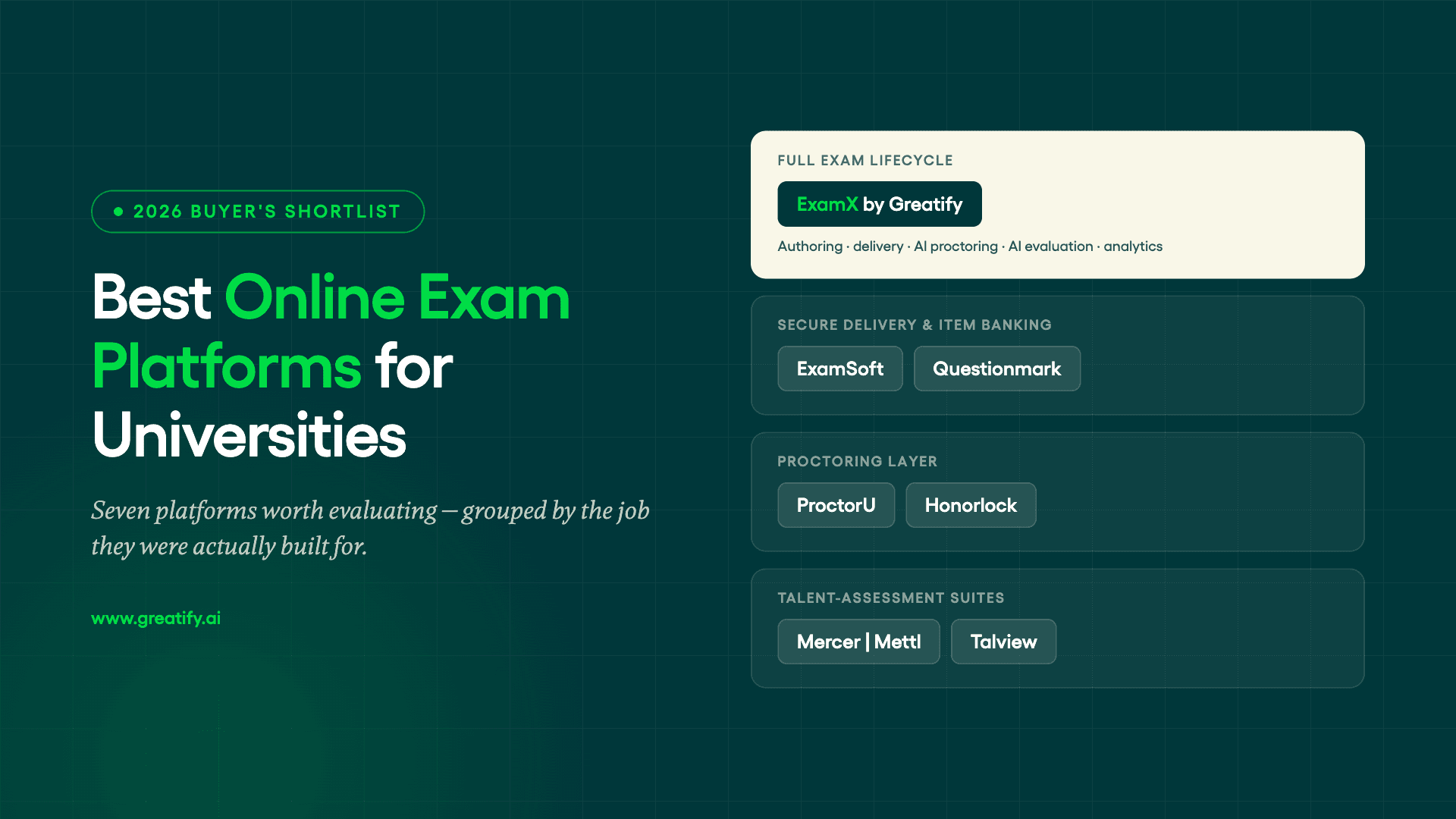
This shortlist is for teams that want to stop managing a stack and start managing outcomes. It covers nine platforms worth serious evaluation in 2026 — seven global names and the two India-based platforms that appear in almost every Indian university tender —, organised around what each one does best, where it stops, and which kind of institution it actually fits. One note on scope: we state no pricing as fact for any vendor, because none of them publishes it — costs move with institution size, contract structure and feature tier.
What universities actually need in 2026
Three expectations have hardened since the remote-exam scramble of the early 2020s. First, low-friction proctoring is now the default ask — students should not need a 45-minute setup call before a high-stakes exam. Second, accreditors want integrity you can demonstrate, without making every exam feel adversarial to the student sitting it. Third — and most often missed in vendor demos — real university exams are not all multiple choice. Semester papers include long-form handwritten answers, diagrams and equations, and most platforms on the market quietly assume those don't exist.
Hold those three against any shortlist, this one included.
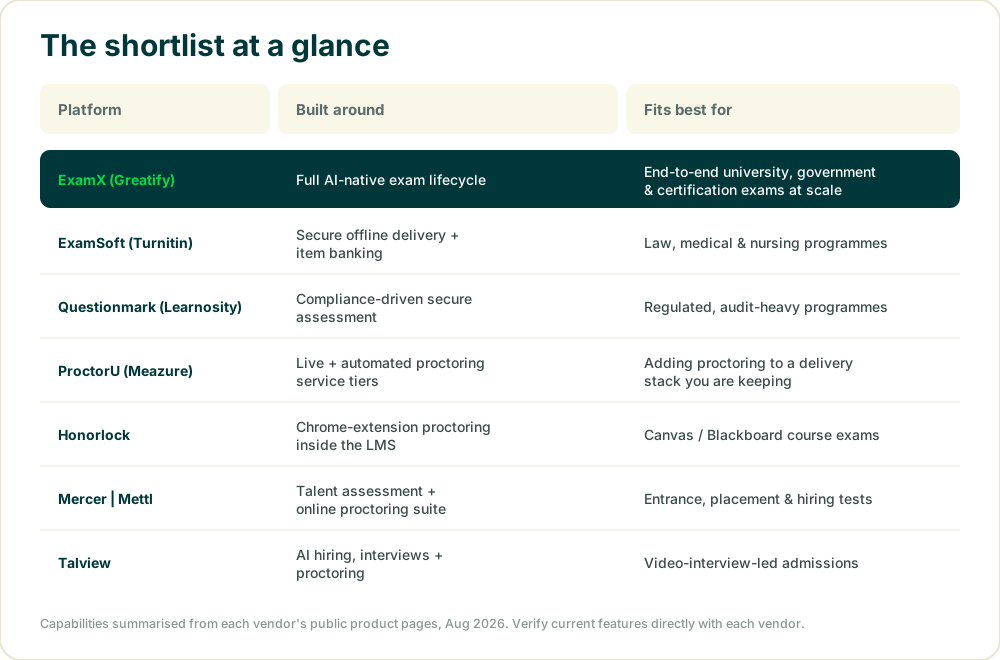
The shortlist at a glance
ExamSoft (Turnitin)
ExamSoft is well established in professional and health-sciences education. Its Examplify app delivers typed, locked-down exams that keep running when the internet does not — a genuine selling point for licensure environments — and its item banking and psychometric tagging suit accreditation-driven programmes in medicine, dentistry, nursing and law.
Where it stops: proctoring is not in the base product. Identity checks (ExamID) and recorded AI-plus-human-review proctoring (ExamMonitor) are paid add-ons, and there is no live-intervention option — so remote-heavy institutions often layer another proctoring vendor on top, which is the two-contract problem this shortlist is trying to solve. Authoring is manual, and essays are marked by hand.
Questionmark (Learnosity)
Questionmark, part of Learnosity since 2021, is one of the longest-tenured names in secure assessment. Its strengths are compliance-shaped: a wide range of question types, detailed audit trails, and reporting built to prove things to regulators. It serves higher education alongside a substantial enterprise and workforce business.
Where it stops: the workflow reads more enterprise-IT than faculty-friendly, authoring at scale takes real configuration, and proctoring is not native — it comes through third-party integrations. Strong choice for regulated programmes; a heavier lift as the everyday exam platform for academic departments.
ProctorU (Meazure Learning)
ProctorU runs one of the larger remote-proctoring operations, with tiers from fully automated through professionally reviewed recordings up to Live+, where a trained human proctor monitors the session and can intervene. Some licensing and accreditation contexts require precisely that.
Where it stops: ProctorU is a proctoring service, not an exam platform. Your exams are authored, delivered, graded and analysed somewhere else, and adding ProctorU adds a vendor rather than replacing one. Live proctoring also carries per-session economics and scheduling that change the maths at thousands of concurrent candidates. We compared it in depth in ExamX vs ExamSoft vs ProctorU.
Honorlock
Honorlock has earned a strong higher-education reputation for reducing friction: it runs as a Chrome browser extension rather than a separate client, sits directly inside Canvas and Blackboard through LTI, and uses AI monitoring that can escalate to a live proctor popping into the session when something looks genuinely wrong. For LMS-based course exams, students and faculty barely leave their existing workflow.
Where it stops: like ProctorU, it is a proctoring layer. Authoring, item banking and analytics live in your LMS or elsewhere, it is tied to Chrome, and it is not designed for high-stakes exams that live outside the LMS — a multi-campus semester examination cycle, for instance.
Mercer | Mettl
Mercer | Mettl is a talent-assessment and proctoring suite with real strength in high-volume entrance tests, placement drives and corporate certification — psychometrics, coding assessments and AI proctoring included. Universities running admissions or employability testing use it widely.
Where it stops: its roots are in HR and recruitment, and the product priorities show it. Faculty authoring workflows, course-aligned item banks and handwritten descriptive papers are not its centre of gravity. We keep a detailed side-by-side at ExamX vs Mercer | Mettl.
Talview
Talview blends AI-driven video interviewing with proctored assessments, and its recent work on impersonation and deepfake detection is genuinely interesting for admissions screening. Institutions that need video-based evaluation alongside written tests — competency programmes, interviews at scale — are its natural users.
Where it stops: it is recruitment-led. For traditional academic examinations at scale — midterms, finals, semester descriptive papers — its authoring and evaluation tooling is not the primary design focus.
CodeTantra and Eklavvya: the India-based options
Two platforms come up in almost every Indian university evaluation and almost never in global shortlists. CodeTantra (Hyderabad, founded 2014) sells a “virtual university”: live classes, an LMS, coding labs and proctored exams on one platform, with composite recording of every test session and auto-graded programming questions. Its customer list leans towards engineering institutions, from IITs and IISERs to LPU and SASTRA.
Where it stops: it is LMS-first, subjective essays are marked manually, and it publishes no proctoring accuracy, concurrency, uptime or certification figures. Our CodeTantra vs ExamX comparison goes deeper.
Eklavvya (Splashgain, Pune) is a broad assessment suite: proctored online tests in image, video, auto and 360-degree modes, AI interviews, and an onscreen-marking product that lets examiners mark scanned paper scripts from anywhere — which it says NMIMS and Sharda University use at six-figure answer-sheet volumes. It states CERT-IN and ISO 27001 certification and publishes a free tier of 25 exams.
Where it stops: handwritten exams still start on paper and pass through a scanner, AI evaluation sits on its Enterprise tier, and its 99.96% proctoring accuracy is self-reported with no false-positive rate. See Eklavvya vs ExamX for the full comparison.
ExamX by Greatify
ExamX takes a different architectural position from everything above: instead of solving one slice, it was built to own the entire exam lifecycle in a single system. Faculty generate papers with AI from any source content — 20+ question types, Bloom's-taxonomy coverage — and deliver them on web, iPad or Android with lockdown and offline support. AI proctoring runs at 99.2% detection accuracy with under 0.1% false positives, at up to 100,000+ concurrent candidates, with a 99.9% uptime SLA and SOC 2, ISO 27001 and GDPR compliance behind it.
The differentiator no other platform on this shortlist offers: students write full handwritten descriptive answers, diagrams and equations on tablets with a stylus, and rubric-aware AI evaluates them with faculty holding the final override. For universities whose real exams are long-form papers, that is usually the deciding row on the comparison sheet. Analytics close the loop — item-level and cohort performance land in the same platform where the exam was authored, the moment the cycle ends.
The proof point is public: SRM Institute of Science & Technology ran 80,000+ fully paperless exams across five campuses on roughly 2,000 tablets — answer scripts ready to evaluate within 10 minutes, zero disruptions across 45 days. The numbers are in the SRM case study.
Where it stops: ExamX is purpose-built for structured, high-stakes examination. If your need is informal LMS-embedded quizzing or video-interview screening, the specialists above serve those specific jobs better. And there is no live human proctor option — integrity is automated by design.
How to narrow it down
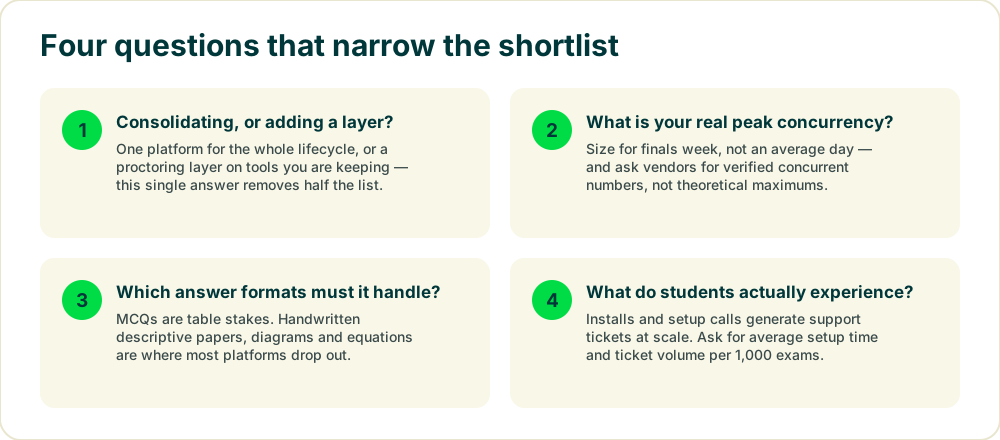
Four questions remove most of this list before you ever sit through a demo. Are you consolidating vendors or adding a layer to tools you are keeping? That answer alone splits the shortlist in half. What is your verified peak concurrency — finals week, not a quiet Tuesday? Which answer formats must the platform actually handle, because handwritten descriptive papers eliminate most contenders immediately? And what does the student experience look like at scale — installs and setup calls turn into support tickets by the thousand.
Put those four answers in your RFP and the vendor conversations get short and honest very quickly.
Three mistakes universities make choosing exam platforms
Buying for the average day. A platform that handles a Tuesday quiz gracefully can fall over during finals week, when a large share of the student body tests at once. The number that matters is verified peak concurrency under proctoring load — and vendors should be willing to put it in the contract, not just the slide deck.
Demoing with multiple choice only. Every platform demos beautifully with MCQs; they are the easiest thing in assessment to deliver and grade. If your real examinations include long-form handwritten papers, diagrams or equations, make the vendor run that exam in the demo. It is the fastest way to separate platforms built for universities from platforms adapted to them.
Comparing licence price instead of stack cost. A cheaper point solution that needs two companions is not cheaper. Count the contracts, the integrations someone must own, the compliance reviews, and the support lines your team calls at 9 pm before a major exam. That total is the honest number to compare — and it is the number that usually decides between adding a layer and consolidating. We walked through this arithmetic in more depth in our three-way comparison.
Best online exam platforms for universities: FAQs
What is the best online exam platform for universities in 2026?
It depends on the job. For a proctoring layer on an existing LMS, Honorlock and ProctorU lead. For secure offline typed delivery in professional programmes, ExamSoft is established. For the full lifecycle — AI authoring, delivery, proctoring, AI evaluation of descriptive answers and analytics in one platform — that is what ExamX was built for.
Which of these are full platforms and which are proctoring layers?
ProctorU and Honorlock are proctoring layers. ExamSoft and Questionmark centre on secure delivery and item banking. Mercer | Mettl and Talview are talent-assessment suites. ExamX covers the whole lifecycle in one system. Of the India-based pair, CodeTantra bundles exams into an LMS and Eklavvya pairs proctored tests with onscreen marking of scanned paper scripts.
Do any of these platforms generate questions with AI?
ExamX does natively — papers generated from any content, 20+ question types, reviewed and published in the same system. Elsewhere, authoring is manual or the generation loop runs through separate tools.
Can any of them handle handwritten descriptive exams?
Only ExamX on this shortlist: handwritten answers on tablets, evaluated by rubric-aware AI with faculty override. The rest centre on typed, objective, coding or video formats.
What compliance certifications matter?
SOC 2, ISO 27001 and GDPR are the baseline — ExamX holds all three with a 99.9% uptime SLA. Add FERPA alignment and data-residency requirements as your region and accreditor demand, and verify certificates directly with every vendor.
How much concurrent capacity should we plan for?
Size for finals week. Ask for verified concurrent numbers, not theoretical ones — ExamX scales past 100,000 concurrent candidates and sustained 45 days of multi-campus exams at SRM without disruption.
The bottom line
Every platform here is good at the job it was designed for; the expensive mistake is buying a platform for a job it was never designed to do. If your gap is one layer, pick the specialist for that layer. If you are done managing three exam vendors — or your exams include the handwritten descriptive papers most tools ignore — the shortlist narrows to one quickly. Book a demo of ExamX and bring your largest concurrent exam scenario to the conversation.
Competitor capabilities summarised from each vendor's public product pages (including CodeTantra and Eklavvya), September 2026. Verify current features, certifications and pricing directly with each vendor during procurement.