According to the HEPI/Kortext Student Generative AI Survey 2025, 88% of UK students now use generative AI in their assessment work — up from 53% a year earlier. Read that as a warning or an opportunity, but it settles one argument: the way students engage with knowledge has already changed. Meanwhile, at most institutions, the exam questions those students face are still written the old way — by hand, one at a time, in Word documents on a shared drive.
That gap is closing fast. AI question authoring has moved from experiment to standard practice in serious assessment programmes. This guide covers how it actually works, why manual item writing is struggling, and what to look for when you evaluate a tool.
What AI question authoring actually does
AI question authoring uses large language models inside a structured generation pipeline to produce exam questions from source material. You provide the inputs — a syllabus unit, lecture notes, a textbook chapter, a learning objective — along with parameters like question type, difficulty and taxonomy level. The system drafts items aligned to those parameters.
This is not the same thing as asking a chatbot to write a quiz. A purpose-built pipeline is designed to follow frameworks like Bloom's taxonomy, avoid the classic item-writing flaws (implausible distractors, grammatical cues that give the answer away, stems that test reading comprehension instead of the concept), and output items in formats a delivery platform can use directly. The result feeds an exam — it does not sit in a document waiting for someone to copy and paste it.
Why manual question writing can't keep up
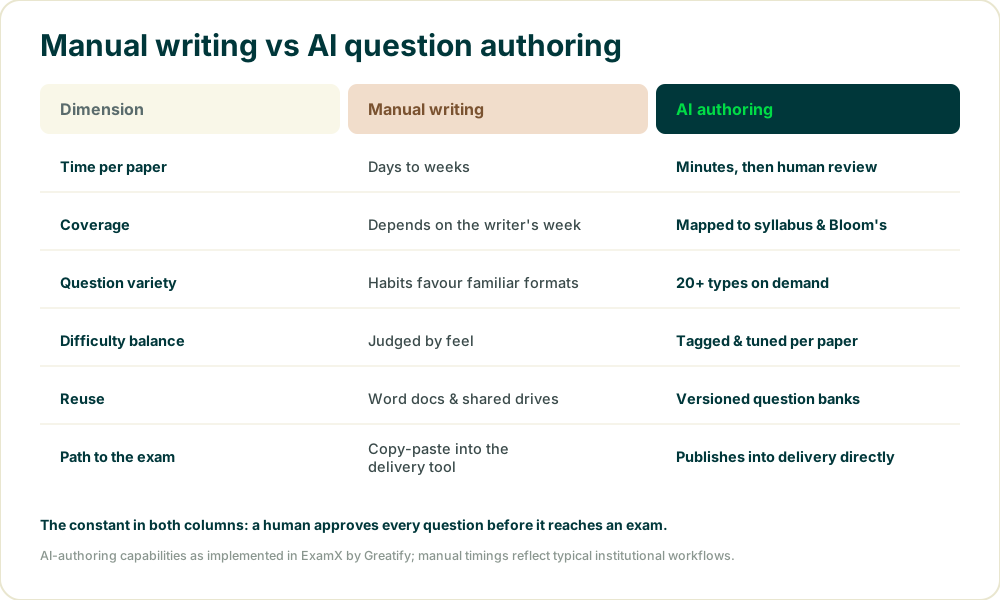
Manual item writing was never efficient; it was just the only option. A subject-matter expert drafts a question, checks it for clarity and unintended cues, routes it through editorial review, and then someone reformats it for the delivery platform. A balanced 60-question paper takes days of expert time. An item bank of a few hundred questions takes a semester. And the output quality depends on which faculty member wrote it, in which week of term.
Volume pressure makes this worse every year. More programmes, more re-sits, more certification cycles — and a stronger integrity reason to refresh papers often, because recycled questions circulate among students faster than ever. Exam regulators are pushing the same direction: India's University Grants Commission calls question-bank-based paper setting "a much needed reform", precisely because well-stocked banks make papers both better-balanced and harder to leak.
How the generation pipeline works
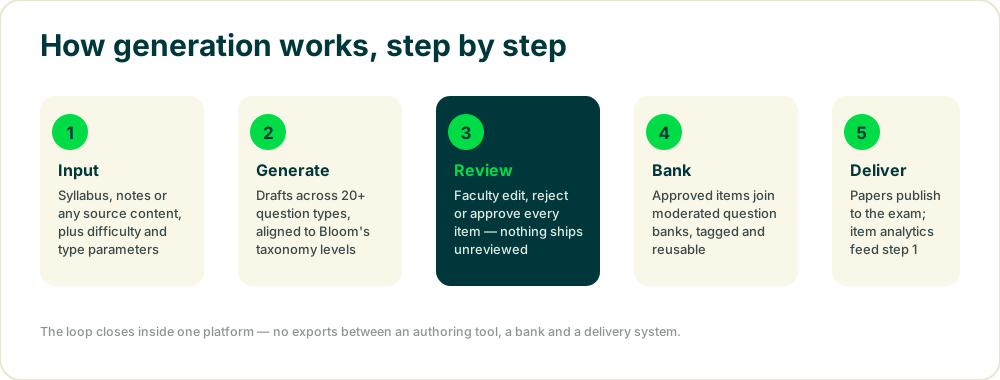
Five steps, and the third one matters most.
Input. Faculty point the system at real course material and set the parameters — how many items, which types, what difficulty spread, which Bloom's levels.
Generate. The model drafts candidate items against those parameters. In ExamX that spans 20+ question types, from multiple choice to long-form descriptive prompts, each tagged by difficulty and taxonomy level.
Review. Nothing ships unreviewed. Faculty edit, reject or approve every generated item — the AI removes the drafting bottleneck, not the subject-matter expert. In practice reviewers work several times faster than writers, because judging a drafted item is quicker than staring at a blank page.
Bank. Approved items join moderated question banks — tagged, versioned and reusable, so next semester's paper starts from an asset instead of from scratch.
Deliver and learn. Papers publish into delivery directly, and post-exam item analytics — which questions discriminated well, which were too easy — feed the next generation cycle.
The quality question, answered honestly
The fair worry about AI-generated questions is quality: does a model actually understand the syllabus, or does it produce plausible-looking items that test nothing? The honest answer is that raw model output is uneven — which is exactly why the review step exists and why the pipeline matters more than the model. Generation against your actual source content keeps items anchored to what was taught. Taxonomy and difficulty tagging force the paper's shape to be a decision rather than an accident. And faculty approval means the exam is still authored by your institution — the AI just did the first draft.
The practical test when you evaluate any tool: generate items from your own course material, hand them to the faculty who teach it, and count how many survive review unchanged. That number tells you more than any demo.
Where ExamX fits
In ExamX, question authoring is not a separate product — it is the first stage of one platform that also delivers the exam, proctors it with AI, evaluates the answers (including handwritten descriptive scripts) and reports the analytics. That matters for authoring specifically, because the loop closes: generated items flow into moderated banks, banks build papers, papers deliver on web and tablets, and item-level performance data flows back to improve the next paper. No exports, no reformatting, no second vendor.
At SRM Institute of Science & Technology, that end-to-end flow ran 80,000+ fully paperless exams across five campuses in one cycle — the authoring-to-analytics numbers are in the SRM case study.
What to look for when evaluating tools
- Generation from your source content, not just a topic keyword — anchoring is what keeps items on-syllabus.
- Bloom's-taxonomy and difficulty controls you set per paper, not a single "make questions" button.
- A faculty review workflow with edit, reject and approve — and moderated question banks behind it.
- Descriptive and essay prompt support, not only multiple choice — real university exams are long-form.
- A closed loop into delivery and analytics, so approved items become exams without copy-paste.
AI question authoring: FAQs
What is AI question authoring?
Using large language models in a structured pipeline to draft exam questions from source material — aligned to Bloom's taxonomy, tagged by difficulty, output in delivery-ready formats, and reviewed by faculty before anything reaches an exam.
Is it the same as asking ChatGPT to write a quiz?
No. A chatbot gives you text to check and paste somewhere. A purpose-built pipeline generates against your course content and parameters, routes items through review and question banks, and publishes them into the exam in one system.
Do humans still review the questions?
Yes — every item, before it can appear in a paper. AI removes the drafting bottleneck; faculty keep final authority.
What question types can it generate?
ExamX generates across 20+ types, from multiple choice to long-form descriptive prompts, with full Bloom's coverage and difficulty tags.
Why are institutions moving away from manual writing?
Volume, consistency and integrity. Papers take days to write by hand, coverage depends on habit, and with 88% of students using generative AI in assessment work, recycled questions are a growing risk — fresh papers every cycle need generation.
Does generation improve exam security?
It helps: large refreshed banks make leaks and recycling less damaging — the reform India's UGC explicitly recommends — and randomised papers plus AI proctoring at delivery close the loop.
Where this is heading
The institutions adopting AI question authoring first are not the ones chasing novelty — they are the ones running the most exams, because that is where days-per-paper hurts most. The pattern is consistent: AI drafts, faculty judge, banks grow, papers get fresher, and expert time moves from formatting questions to improving them. If you want to see the pipeline run on your own course material, book a demo and bring a syllabus.
Survey figures from the HEPI/Kortext Student Generative AI Survey 2025 (Policy Note 61); UGC recommendation from "Evaluation Reforms in Higher Educational Institutions" (2019). Product capabilities describe ExamX by Greatify.