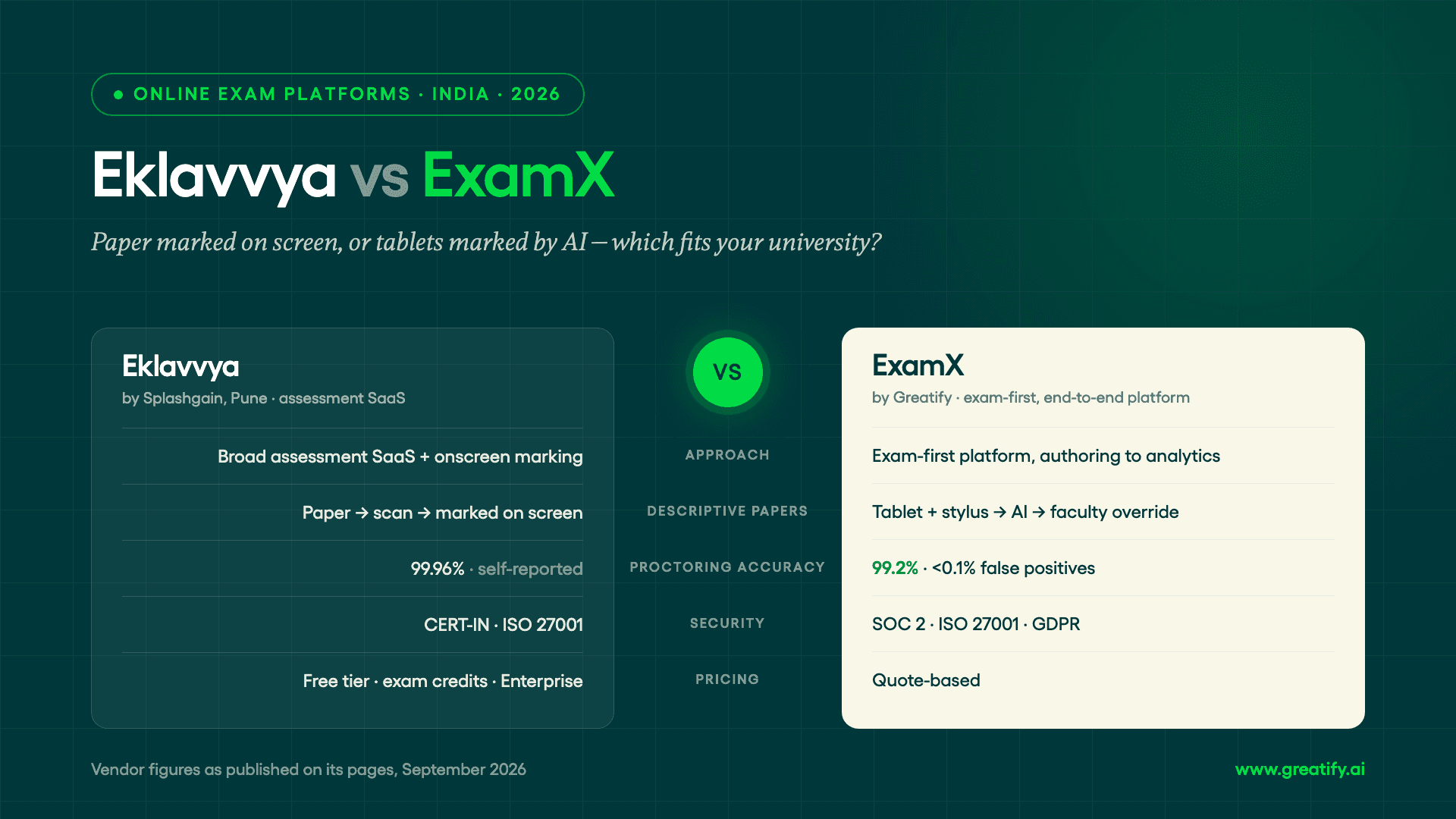
If you run examinations at an Indian university, Eklavvya is almost certainly on your shortlist. It has been marking scanned answer sheets on screen for some of the country's largest universities for years, and its proctored online tests, AI interviews and question-paper generator sit on the same subscription. ExamX by Greatify comes at the same problem from the opposite direction: one exam-first platform where descriptive papers are written on tablets and evaluated by AI, with no paper in the loop at all.
This Eklavvya vs ExamX comparison takes each dimension that decides a procurement in turn, with a verdict on each, then a plain "which fits which" section. A note on spelling: the product is Eklavvya with two v's. "Eklavya" is the common search spelling, and Splashgain's own page says both refer to the same platform. For a shorter side-by-side, see our ExamX vs Eklavvya comparison page; for the product on its own, read our Eklavvya platform review.
Two different shapes of product
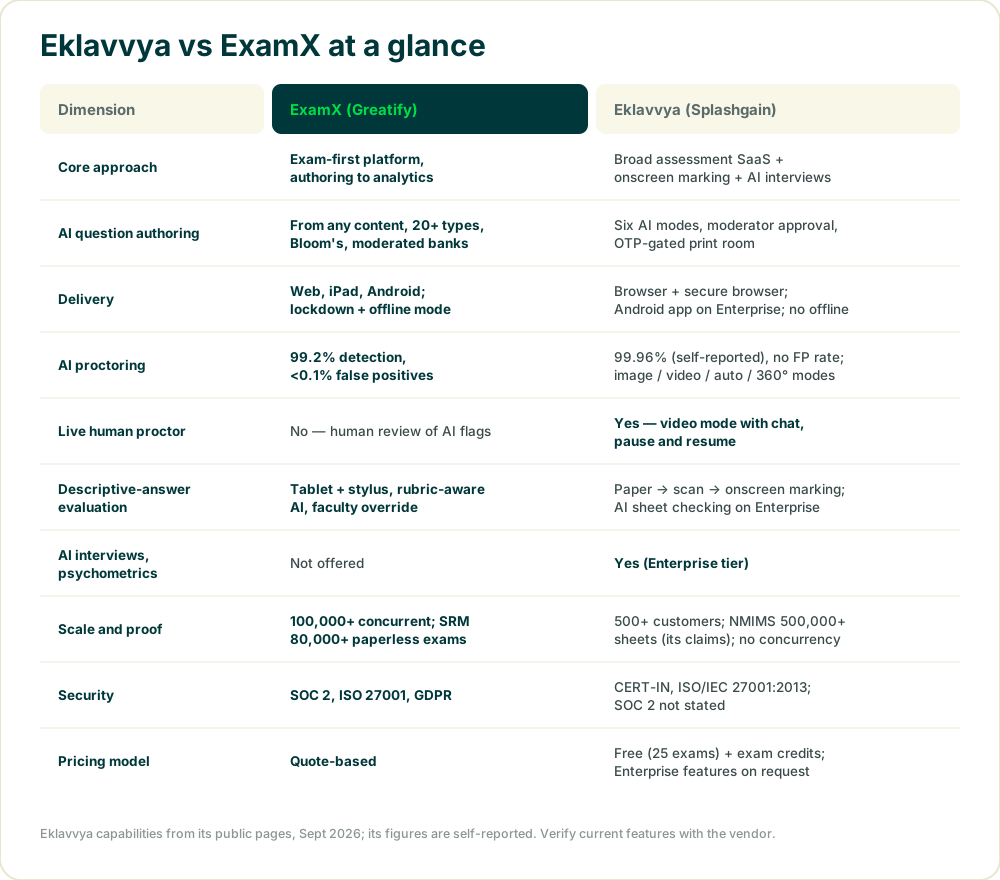
Eklavvya is built by Splashgain Technology Solutions in Pune, founded by Swapnil Dharmadhikari and Samir Kamat. Its about page describes "a plug-and-play platform for objective tests, coding challenges, voice-based assessments, and AI interviews", and the menu is wide: video interviews, psychometric tests, coding assessment, centre-based exams and, the piece universities know it for, an onscreen marking system for scanned paper scripts that Splashgain says is patented. It is a broad assessment SaaS, with AI features arriving as newer layers on top.
ExamX is narrower on purpose. It covers the examination lifecycle end to end — AI question authoring, delivery on web and tablets, AI proctoring, rubric-aware AI evaluation and analytics — and does not try to be a hiring or interview tool. That focus shows in the details that follow: where Eklavvya offers a route to digitise a paper-based process, ExamX removes the paper step.
Verdict: neither shape is wrong. If you want one vendor for admission interviews, psychometrics and exams, Eklavvya's breadth is the advantage. If examinations are the job, ExamX's depth is.
Question authoring: six AI modes vs generation from any content
Eklavvya's question-paper generator offers six AI generation modes — from subject and topic parameters, a pasted paragraph, a syllabus PDF or Word file, last year's paper pattern, a lecture recording or a textbook — and then routes the draft through moderator approval and an OTP-gated print room before exam day. Papers can be produced in English plus Hindi, Marathi and other languages, the question bank carries Bloom's-taxonomy tags, and the page quotes 99.9% uptime for the module. It is designed for a university that still prints and distributes paper.
ExamX authoring starts from any source content — lecture notes, a chapter, a syllabus — and generates across 20+ question types with Bloom's-taxonomy coverage, into moderated question banks that faculty review before anything is published. The paper is delivered digitally, so there is no print room to secure.
Verdict: close on generation, different on what happens next. Eklavvya's print pipeline suits paper exams; ExamX's authoring feeds a digital exam directly.
Delivery: browser and secure browser vs web, tablet and offline
Eklavvya exams run in the browser with a secure-browser lockdown option, and its AI proctoring page says the platform works on mobile, tablet, desktop and laptop, on connections "as low as 0.1 MBPS". A hybrid Android application and centre-based exam support are listed on the Enterprise tier. The exam builder covers sections, shuffling and randomisation, a regional-language interface and document upload during a test. An offline exam mode is not stated publicly.
ExamX delivers on web, iPad and Android inside a lockdown environment, with an offline mode so that a dropped connection never ends an exam. That matters most in exam halls where hundreds of devices share one network.
Verdict: Eklavvya's low-bandwidth image proctoring is a practical answer for remote candidates on poor connections; ExamX's offline mode and native tablet apps are the stronger fit for in-hall, device-based exams.
Proctoring: four modes and a 99.96% claim vs 99.2% with published false positives
Eklavvya's remote proctoring page lists four modes: image proctoring takes webcam photos at intervals (every 30 to 45 seconds, for example) for low-bandwidth regions; video proctoring streams continuously with live chat, pause and resume and a human proctor's environment check; auto proctoring runs continuous AI analysis; and identity verification has the candidate show an ID card to the webcam for proctor approval. A 360-degree option using a secondary camera is an Enterprise feature. Its homepage adds face matching, multiple-person and device detection, and "anti-AI prevention" based on typing-pattern analysis. The headline figure, repeated across its pages, is a 99.96% accuracy rate — Eklavvya's own claim. A false-positive rate is not stated publicly.
ExamX AI proctoring publishes both halves of the accuracy trade-off: 99.2% detection accuracy and under 0.1% false positives. Identity verification, face and gaze tracking and real-time alerts for multiple faces, device swaps and off-screen activity run at up to 100,000+ concurrent candidates. Flags go to human reviewers and no penalty is ever applied automatically. What ExamX does not offer is a live human proctor watching and chatting during the session; Eklavvya's video mode does.
Verdict: Eklavvya wins on mode variety and the human-in-the-session option. ExamX wins on transparency — a detection rate without a false-positive rate tells you nothing about how much review work lands on your staff — and on documented concurrency.
Descriptive-answer evaluation: the heart of the comparison
Eklavvya's onscreen evaluation keeps the paper exam intact. Students write on paper; scripts are scanned, masked and uploaded; examiners mark them on screen, with automatic totals, moderation and audit logs. The page claims "100,000+ answer sheets 80% faster", 95% marking accuracy and four to six minutes per sheet. Its case studies put numbers on the model: NMIMS reports 500,000+ answer sheets marked by 500+ evaluators, with the result timeline cut from 40 days to 10; Sharda University cites 100,000+ answer sheets across 200+ courses for 25,000+ students; a TISS dean is quoted evaluating "more than 100,000 answer sheets in each session". These are Eklavvya's own figures, but the product is real and widely deployed. On the Enterprise tier, an AI answer-sheet checking layer transcribes the scanned handwriting with OCR and grades it against rubrics and model answers, with human oversight; Eklavvya cites independent research for a 31% reduction in grading time per response.
ExamX takes the paper out. Students write descriptive answers by hand on a tablet with a stylus, so the script exists digitally the moment the exam ends — no scanning, masking, transport or storage. Rubric-aware AI evaluates each answer against the faculty's marking scheme, and faculty see the AI's marks alongside the script and hold the final override. At SRM, scripts were ready to evaluate within about 10 minutes of an exam ending, against roughly a week on paper, across 80,000+ exams and five campuses — and 3M+ sheets of paper were never printed.
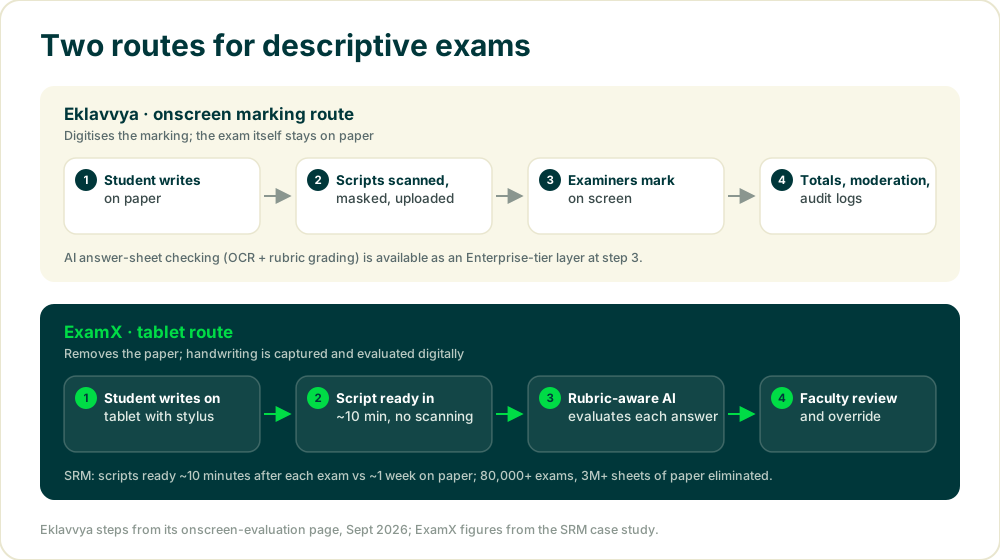
Verdict: if your university will keep writing on paper for the next few years, Eklavvya's onscreen marking is the proven way to speed up what happens after the exam. If you are ready to move descriptive exams onto tablets, ExamX removes the scanning stage entirely and evaluates the handwriting natively; tablet-and-stylus capture is not something Eklavvya's pages describe.
Scale and proof
Splashgain's page states 500+ customers in 17+ countries, and Eklavvya's exam-management page says 300+ education institutes use it. It also cites East Africa University running 35,000+ proctored exams in three weeks, and its homepage lists "100K+ exam nodes pan-India" and a 99.9% uptime SLA. A concurrent-candidate figure is not stated publicly.
ExamX publishes 100,000+ concurrent candidates and a 99.9% uptime SLA, and its proof point is a single, fully documented deployment: SRM Institute of Science and Technology ran 80,000+ paperless exams on roughly 2,000 tablets across five campuses over 45 continuous days, peaking at about 1,800 concurrent candidates, with zero examination disruptions.
Verdict: Eklavvya has the longer customer list and more case studies, most of them about marking scanned paper. ExamX has the deeper single proof of a paperless, tablet-based exam season at university scale.
Security and compliance
Eklavvya's homepage lists CERT-IN certification and ISO/IEC 27001:2013, plus encryption at rest and in transit, role-based access with audit trails and "GDPR-compliant data handling". SOC 2 is not stated publicly. CERT-IN empanelment is a genuine advantage in Indian public procurement, where tenders often name it.
ExamX holds SOC 2, ISO 27001 and GDPR compliance. If your tender lists CERT-IN, ask both vendors directly; if it lists SOC 2, only one of the two currently states it.
Verdict: level on ISO 27001. Eklavvya adds CERT-IN, ExamX adds SOC 2. Match the badges to your tender rather than counting them.
Pricing: a free tier and exam credits vs a quote
Eklavvya's pricing page is unusually open about structure, if not about numbers. There is a Free plan capped at 25 exams, then Professional and Enterprise plans on "Contact Us". Usage is metered in exam credits — 100 candidates in one exam consume 100 credits — with storage tiers of 1 GB, 10 GB and 20 GB. Read the Enterprise column carefully: AI interviews, AI descriptive evaluation, the AI question bank generator, 360-degree proctoring, onscreen marking, the Android app and an account manager are all Enterprise-only. The features that make Eklavvya interesting to a university are the ones with no published price.
ExamX is priced on request against your exam volumes and formats; there is no self-serve tier, which matters to a department that wants to trial a tool before talking to anyone.
Verdict: Eklavvya is easier to start with; both are quote-based by the time you reach the features universities actually buy. Ask each vendor for a price per candidate-exam at your annual volume, with proctoring and descriptive evaluation included, and compare that number.
Which platform fits which university?
Choose Eklavvya if your exams will stay on paper for now and the bottleneck is marking. Its onscreen evaluation has large Indian universities behind it. Choose it too if you want AI interviews, voice assessments or psychometric instruments on the same contract, or if you need a human proctor chatting with candidates during the session.
Choose ExamX if you are ready to take descriptive exams fully paperless on tablets, want AI to evaluate the handwriting with faculty holding the override, and run synchronised exam weeks across campuses where offline resilience and published concurrency matter.
Where ExamX stops
ExamX has edges worth naming. It does not offer AI interviews, psychometric instruments or a live human proctor option. It is not built to mark scanned paper scripts: its evaluation model assumes the answer was written on a tablet. And it has no free tier. If any of those is a hard requirement, Eklavvya covers it and ExamX does not.
Eklavvya vs ExamX: frequently asked questions
Is ExamX an Eklavvya alternative?
Yes, for examinations. Eklavvya is a broad assessment SaaS with interviews, psychometrics and onscreen marking; ExamX is an exam-first platform with AI authoring, tablet delivery, AI proctoring and AI evaluation of handwritten answers. For paperless descriptive exams, ExamX is the more direct alternative.
What is the difference between onscreen evaluation and AI evaluation?
Onscreen evaluation digitises the marking of paper scripts — scan, mask, mark on screen by human examiners. AI evaluation grades the answer against a rubric. Eklavvya does the former with an optional AI layer on Enterprise; ExamX evaluates tablet-written handwriting with AI and faculty override.
Does Eklavvya support handwritten answers on tablets?
Its published flow is paper first — written on paper, scanned, then marked on screen or OCR-transcribed for AI checking. Tablet-and-stylus capture is not described on its pages. ExamX is built around it.
Which is better for Indian universities, Eklavvya or ExamX?
Keeping paper and want faster marking: Eklavvya's onscreen evaluation, which its case studies say NMIMS, Sharda and TISS use. Going paperless on tablets with AI evaluation at scale: ExamX, proven on 80,000+ exams at SRM.
How does Eklavvya's 99.96% proctoring accuracy compare with ExamX's 99.2%?
Not directly comparable. Eklavvya publishes an accuracy rate without a false-positive rate; ExamX publishes 99.2% detection with under 0.1% false positives and human review of every flag. Ask each vendor what accuracy measures.
Does Eklavvya have a free plan, and does ExamX?
Eklavvya lists a Free plan of 25 exams, with Professional and Enterprise on request and most university features Enterprise-only. ExamX has no free tier; pricing is quoted against your volumes.
The bottom line
Eklavvya and ExamX solve the descriptive-exam problem from opposite ends. Eklavvya makes the paper exam faster to mark and adds interviews, psychometrics and proctoring around it. ExamX makes the paper disappear and evaluates the handwriting itself. Pick by where your university wants to be in three years, not by feature count.
If that destination is paperless, tablet-based exams with AI evaluation and faculty in control, book a demo and put your own question papers and answer scripts through ExamX. If you are still building the shortlist, our guide to the best online exam platforms for universities and our online exam software in India page cover the wider field.
Eklavvya capabilities and pricing tiers summarised from its public pages, September 2026. Verify current features, certifications and pricing directly with the vendor during procurement.