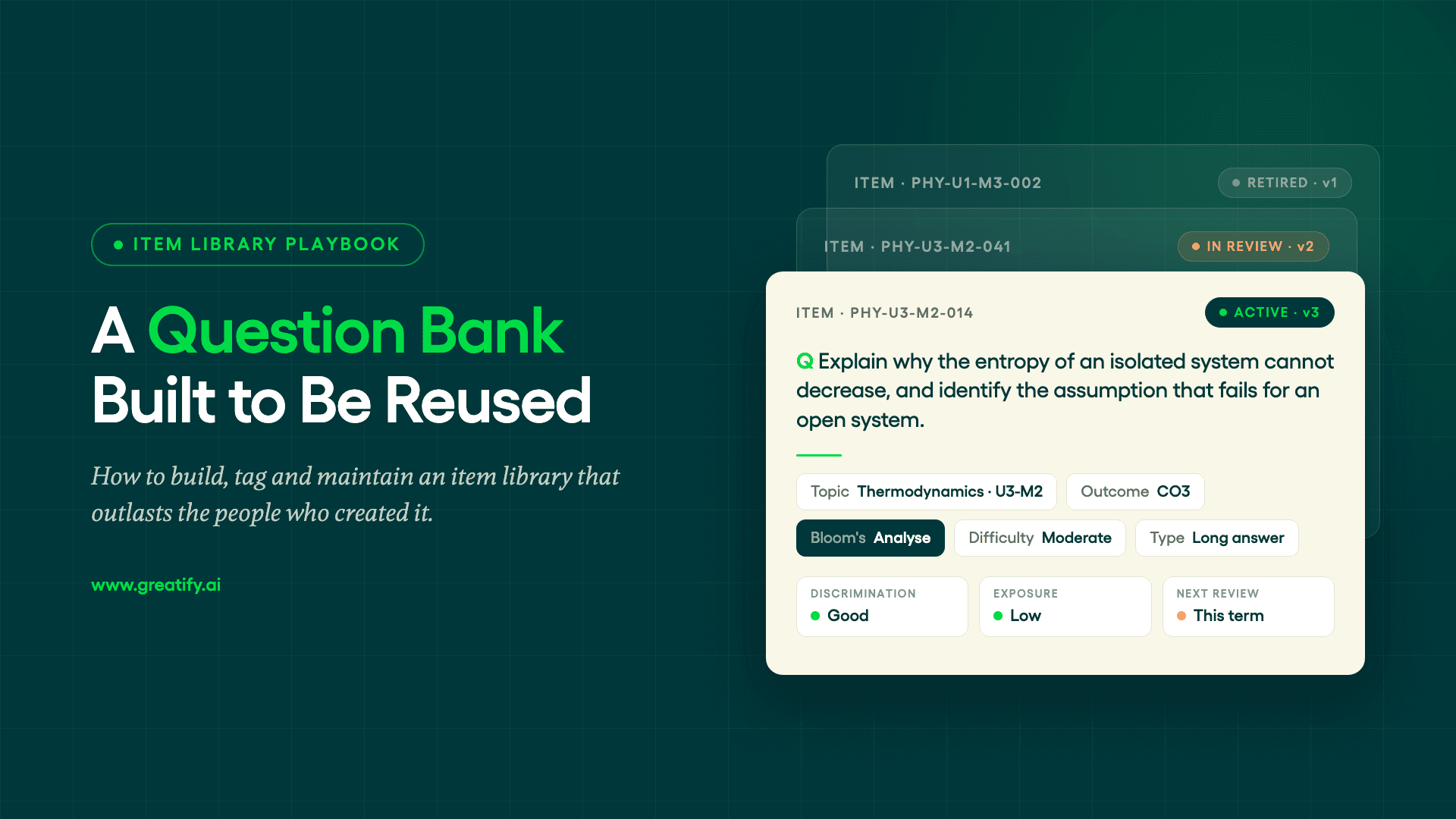
Question bank software is a system for authoring exam questions once, tagging them against a defined taxonomy, tracking how each one performs, and reusing them across papers and years. The word that matters in that sentence is reusing. Any spreadsheet can store questions. What separates an item bank from a folder of Word files is whether a colleague who never met the original author can find the right item, trust its difficulty label, and know whether this cohort has already seen it.
Most institutional question banks fail that test within a few years — not because the software was bad, but because nobody decided what the tags meant before the first few hundred items went in, review got skipped when deadlines were tight, and nothing was ever retired. What follows is the five-step process we recommend, the mistakes that undo it, and an honest note on how much software can fix.
What question bank software actually needs to do
An item bank has six jobs: let authors write questions with real formatting — equations, diagrams, images, passages — in every question type your papers use; attach structured tags to each item rather than free-text notes; let a paper-setter search and filter on those tags in seconds; record how often the item was used and how well it separated strong candidates from weak ones; control who can draft, approve and publish; and keep versions, so a fix to a flawed stem doesn't silently rewrite the history of every paper that used the old wording.
India's University Grants Commission put the case plainly in its Evaluation Reforms in Higher Educational Institutions document: setting papers through a question bank system is “a much needed reform in the examination system”, because traditional paper setting by a few invited experts “may lead to repetition of questions” that “just test information recall”. The same document recommends appending codes to each question for the learning outcome, the syllabus topic, the difficulty level and the discrimination ability — which is, in software terms, a tagging taxonomy.
Step 1: define your taxonomy before adding a single item
This is the step everyone skips and everyone regrets. A taxonomy is the fixed set of dimensions every item must be tagged on, plus the allowed values for each. Decide it with the people who will set papers as well as the people who write items, because paper-setters are the ones who search.
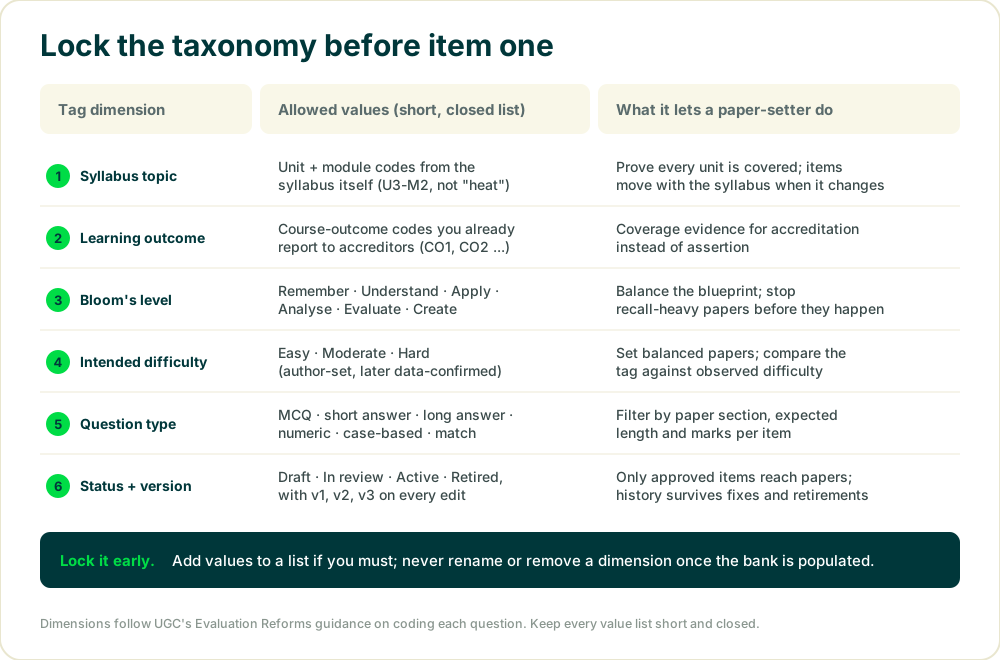
Four dimensions do most of the work. Syllabus topic, mapped to your real unit and module codes so an item moves with the syllabus when it is revised. Learning outcome, using the course-outcome codes your accreditation already requires, so the bank can prove coverage instead of asserting it. Bloom's level, because a bank that is mostly recall items with a handful at analysis level will produce recall-heavy papers whatever the blueprint says. And intended difficulty, which the author sets and which performance data will later confirm or contradict.
Two more are cheap to add now and painful to retrofit: question type, and a status field (draft, in review, active, retired) with a version number. Keep value lists short and closed. “Medium” and “Moderate” are two different tags to a search filter, and free-text fields drift.
Then lock it. Changing a dimension once the bank is populated means re-tagging everything or living with a library that is half one scheme and half another. Add values if you must; never rename or remove dimensions.
Step 2: build the library systematically
Separate creation from review, and make both visible in the software. The UGC procedure for developing a bank is worth following almost verbatim: specify the learning outcomes to be tested, decide the format, have a panel of experts write or pool questions, review them, pilot them with a sample group, assess difficulty and discrimination, then make the final selection. “Write” and “review” are different steps done by different people. An item that goes straight from an author's editor into the active pool has never been checked for a mis-keyed answer, an ambiguous stem or a distractor that happens to be correct.
Use AI to accelerate the initial population, not to replace review. Drafting from your own syllabus, lecture notes and textbook chapters is where AI question generation earns its place: it turns the slow part — a blank page and a deadline — into a queue of candidates for faculty to approve, edit or reject. In ExamX, generated items arrive with Bloom's-level targeting and a calibrated difficulty, and cannot reach a paper until a reviewer approves them. We covered the pipeline in AI question authoring: how it works.
Build to a blueprint, not to a total. “A few hundred items for this course” produces a few hundred items clustered around the units the authors know best. “Every unit at every Bloom's level in the blueprint” produces a bank that can set balanced papers.
Step 3: tag consistently, or the bank stops being searchable
Consistency comes from three habits. Write a one-page tagging guide with a worked example per dimension, and put it inside the authoring tool where people will see it. Audit a sample of newly tagged items every term — one reviewer, an hour, a checklist — and feed recurring errors back into the guide. And when an item is wrong, outdated or overexposed, retire it rather than delete it. A retired item keeps its history: which papers used it, how it performed, why it was pulled. A deleted item takes all of that with it, and someone will re-author the same flawed question next year.
Intended difficulty is the tag authors get wrong most often — they know the answer and underestimate the item — which is why the bank needs performance data.
Step 4: track item performance and act on it
Once enough candidates have sat an item, its statistics tell you more than any reviewer can. Two metrics carry most of the weight, and the University of Washington's Office of Educational Assessment publishes a clear guide to reading them.
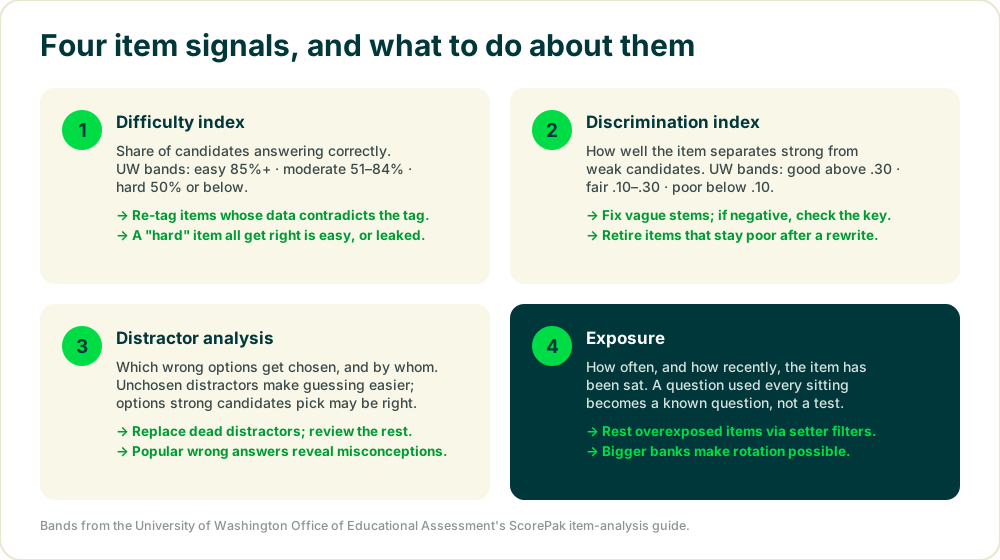
Difficulty index is the percentage of candidates who answered correctly, so a higher value means an easier item. UW's item-analysis report classifies items as easy at 85% and above, moderate between 51% and 84%, and hard at 50% or below. Compare it with the intended difficulty tag: when the two disagree consistently, re-tag the item; when nearly everyone answers a “hard” item correctly, it is either easy or leaked.
Discrimination index measures how well the item separates candidates who did well on the rest of the paper from those who did not. The same report classifies discrimination above .30 as good, .10 to .30 as fair and below .10 as poor, and notes that values seldom exceed .50 in practice. Low discrimination usually means an ambiguous stem. A negative index is a red flag for mis-keying: the strongest candidates are choosing an option the key marks wrong.
Distractor analysis looks at each wrong option. A distractor nobody chooses is dead weight that makes guessing easier; one that high-scoring candidates choose is probably defensible. Exposure is how often, and how recently, the item has been used. An item that appears in every sitting becomes a known question rather than a test.
Automate the feedback loop. Statistics kept in a spreadsheet beside the bank get looked at once; statistics that land on the item record the moment the cycle closes get seen by the next paper-setter. ExamX reports item analysis, difficulty and discrimination metrics as soon as a cycle closes, in the platform where the item was authored.
One caveat: statistics need volume. A small cohort produces noisy numbers, so treat early data as a prompt for review rather than a verdict.
Step 5: maintain the bank over time
UGC recommends a yearly revision of the bank and says about 20% of questions should change each year, to keep pace with the discipline and with syllabus revisions. Whatever your figure, the review cycle needs a date on the calendar and an owner, or it will not happen.
Manage exposure deliberately. Set a rule for how many sittings an item may appear in before it rests, and let the software enforce it through the paper-setting filters rather than memory.
Control contributor access. Authors draft; reviewers approve; a smaller group publishes to the active pool; paper-setters draw from the active pool only. Every change should carry who made it and why — that audit trail is what lets an exams office answer a challenge six months after the paper was sat.
Document decisions, especially the obvious ones. Why “Analyse” and not “Analyze”. Why difficulty has three levels and not five. Why an item was retired. The people asking in three years will not be the people who decided.
Common mistakes that hollow out a question bank
- Tagging after the fact. Items go in untagged “for now”, and now becomes permanent.
- One person owns the bank. When they leave, the taxonomy's logic leaves with them.
- Deleting instead of retiring, which erases performance history.
- Treating AI-generated items as reviewed items. Drafting is fast; reviewing is where quality lives.
- Ignoring negative discrimination. A mis-keyed item that stays active penalises your best students every sitting.
- Measuring the bank by item count. Thousands of recall questions on three popular units is not a big bank; it is a narrow one.
How platform choice affects bank quality
The five steps above are mostly discipline, and no software supplies discipline. What a platform can do is make the disciplined path the easy one: require tags at creation, put review between drafting and the active pool, attach performance data to the item automatically, and make search fast enough that people use the bank instead of their own files. When you evaluate online exam software, put that workflow in the demo script.
ExamX was designed around that idea. Its authoring module covers 20+ question types with bulk import from Word, Excel and PDF, blueprint-based paper building, and question bank management with collaborative and moderation workflows. AI generation from any source content — a syllabus, a textbook chapter, lecture notes — produces items with Bloom's-taxonomy targeting and difficulty calibration, and every generated item flows into a review queue where faculty approve, edit or regenerate it before it can be used. Because authoring, delivery and evaluation live on one platform, item analysis, difficulty and discrimination metrics are available the moment a cycle closes, with faculty override on every AI-evaluated mark.
The scale proof is public: SRM Institute of Science & Technology ran 80,000+ paperless exams across five campuses on roughly 2,000 tablets, with scripts ready for evaluation in about ten minutes and zero disruptions across 45 days. The details are in the SRM case study. A bank feeding that many sittings generates performance data fast.
Where the platform stops: it cannot define your taxonomy, decide your course-outcome codes or chair the review committee. If those are not in place, the fastest authoring tool in the world just fills a badly organised bank faster. And if your immediate need is one good paper rather than a reusable library, our guide to AI question paper generators is the better starting point.
Question bank software: FAQs
What is question bank software?
A system for authoring exam questions once, tagging each one against a defined taxonomy, tracking how it performs, and reusing it across papers and years.
How should exam questions be tagged in a question bank?
Decide the dimensions before the first item goes in, keep value lists short and closed, and lock the scheme. UGC recommends coding each question for learning outcome, syllabus topic, difficulty and discrimination; add question type and status-plus-version, and audit new tags every term.
What is a good item discrimination index?
UW's Office of Educational Assessment classifies values above .30 as good, .10 to .30 as fair and below .10 as poor, and notes that values seldom exceed .50. A negative index usually points to an ambiguous stem or a mis-keyed answer.
How often should a question bank be updated?
Put a yearly review on the calendar with a named owner — UGC suggests about 20% of questions change each year — and act on item data as it arrives between cycles.
Can AI build a question bank?
AI can populate one quickly: ExamX generates items from any source content across 20+ question types with Bloom's targeting and difficulty calibration, and every item waits in a review queue for faculty approval. It cannot define your taxonomy or replace review.
Should old questions be deleted from a question bank?
No. Retire them so the item keeps its history and can be cited if a question is challenged.
The bottom line
A reusable item library is built in order: taxonomy first, then authoring with review in the loop, then consistent tagging, then performance data feeding back into the tags, then a maintenance cycle somebody owns. Software that enforces that order outlasts the people who set it up; software that merely stores questions does not. To see how ExamX runs the whole loop, from AI-drafted items through moderated banks to item analysis the moment a cycle closes, book a demo and bring your current tagging scheme.