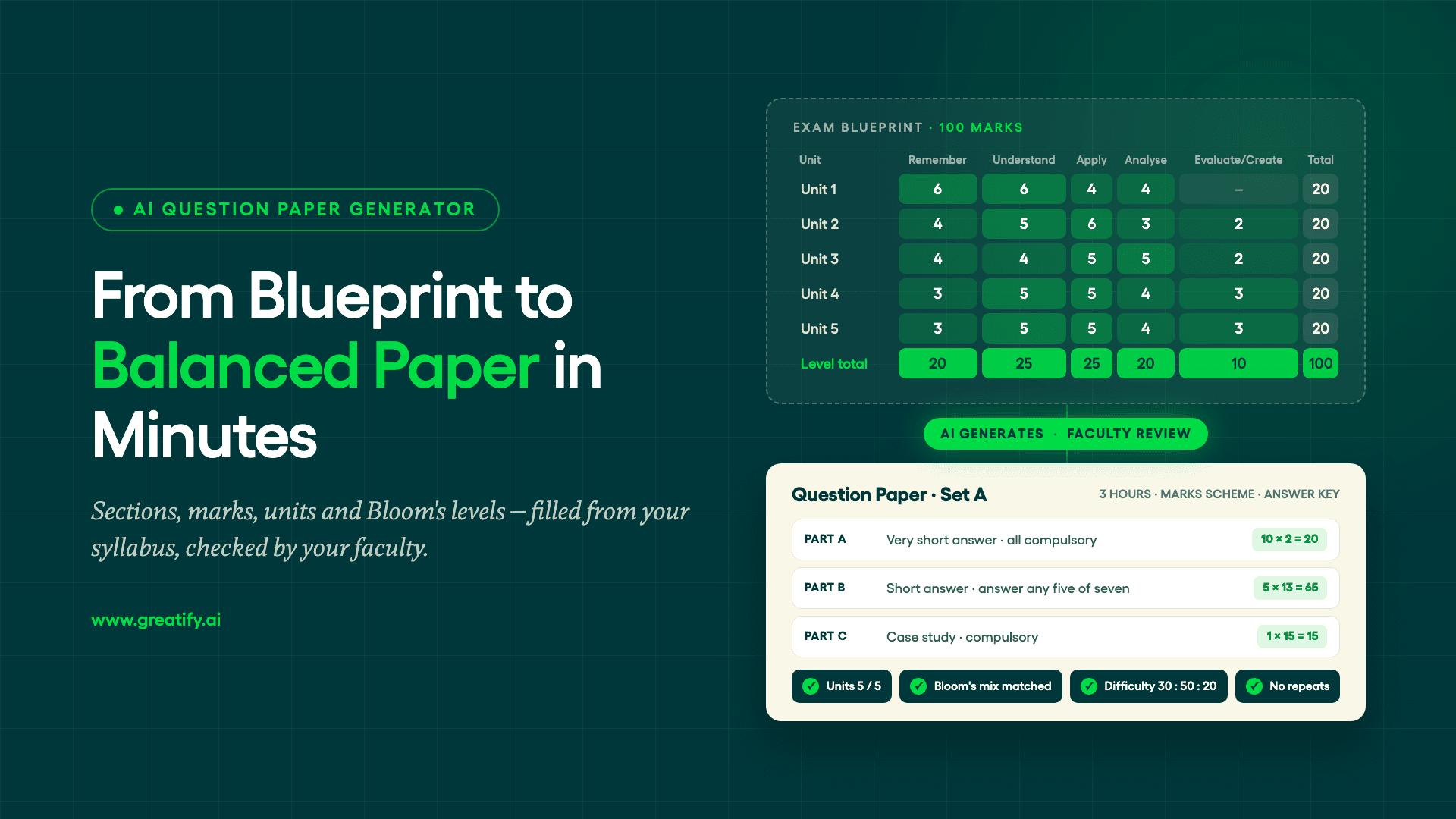
Ask a paper setter what takes the time and they rarely say "writing questions". It is the assembling: making sure Unit 3 is not tested twice while Unit 5 is skipped, that the 2-mark questions can be answered in the minutes the marks scheme implies, that the "analyse" question does not quietly test recall, and that none of it appeared in last year's paper. An AI question paper generator is built for that assembling job — the whole paper, not one item at a time.
This guide is for the people who set, scrutinise and approve question papers: heads of department, controllers of examinations, school exam coordinators, and the faculty who get the paper-setting request three weeks before the exam. For the deeper dive on the generation engine itself, see our guide to AI question authoring; this article stays at the level of the paper.
What an AI question paper generator is (and what it is not)
An AI question paper generator produces a complete, exam-ready question paper from two inputs. The first is source material: a syllabus, lecture notes, textbook chapters, a set of course outcomes. The second is a blueprint that says what the paper should look like — sections, question types, marks per question, unit weighting, difficulty spread, and the cognitive level each question should test. The output is a paper with a marks scheme and an answer key, laid out the way your board or university expects.
A question generator, by contrast, gives you items and leaves you to build the paper. A paper generator starts from the paper's shape and fills it, which is where most of the time goes and most of the mistakes happen. Nor is it a general chatbot with a syllabus pasted in: a chatbot has no idea what your Part B looks like and cannot check its draft against your bank for repeats.
Why "balanced" is harder than it sounds
A balanced paper satisfies several constraints at once, and they pull against each other.
Syllabus coverage. Every unit is tested in proportion to its weight, and none is over-represented because the setter taught it last week. The University Grants Commission's evaluation reforms guidance lists this first among its conditions for question-bank paper setting.
Marks and time. A 2-mark question should be answerable in the time 2 marks are worth. The same UGC document asks that each section specify expected length and suggested time — a rule setters know and forget under deadline.
Difficulty spread. Easy, moderate and hard questions in a deliberate ratio, with each question's difficulty recorded so the ratio can be checked. Without that record, "balanced" is an opinion.
Cognitive levels. A paper of recall questions is easy to set and tells you little. The UGC is blunt: traditional paper setting "may lead to repetition of questions and that they just test information recall, whereas, there is a need to test analytical skills of students".
Duplicates. Two questions on the same concept in different words, or one repeated from last year, both break the paper, and catching them by eye across a few thousand banked items is unreliable.
A human setter juggling all five satisfies the constraints they can see (the marks add up to 100) and misses the ones they cannot (Unit 4 got 6 marks; the "evaluate" question is really "define"). That accounting is exactly what a generator is good at.
The exam blueprint: the input that decides everything
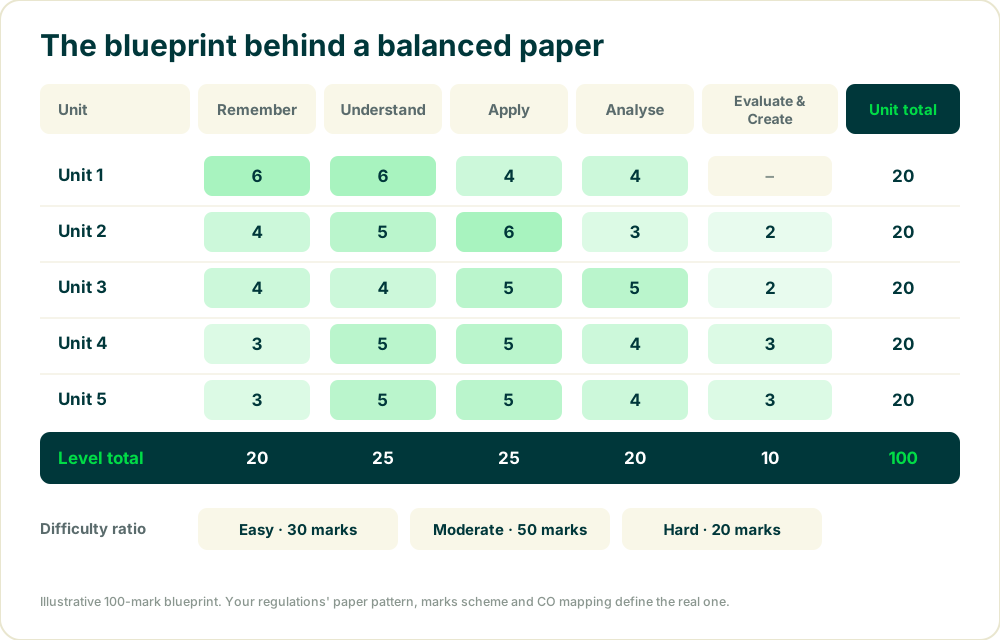
Every serious paper generator starts with a blueprint, and the quality of the paper is decided there. The UGC's note on question-bank paper setting says it plainly: with an ICT-based system "the question paper sets can be drawn within minutes. However the system requires an approved standard format/pattern of the question paper." The pattern is the blueprint.
A workable blueprint records the sections and how many questions each holds; marks per question and any internal choice ("answer any five of seven"); weighting per unit or course outcome; the difficulty ratio; the Bloom's-level mix; the question types allowed per section; and the duration. In Indian universities this usually already exists as the "pattern of question paper" in the regulations, and in schools as the board's blueprint for each subject. The generator needs it in a form it can enforce, not just read. If your blueprint cannot be drawn like the matrix above, the generator cannot balance against it.
How the workflow runs in minutes
1. Define the blueprint. Pick the paper pattern, then set marks per section, unit weights, difficulty ratio and Bloom's mix.
2. Feed the source material. Upload the syllabus, notes or textbook sections the paper should draw from, and point the generator at the question bank so it can reuse approved items and avoid repeats. Anchoring to your material keeps questions on-syllabus; a generator working from a topic name alone drifts into whatever the model learned elsewhere.
3. Review and edit the draft. The generator returns a full paper with a key and a marks scheme, plus the coverage accounting: marks per unit, per level, per difficulty. This is where the setter's expertise moves — from writing to judging. Edit a stem, regenerate a weak distractor, swap in a banked question, reject the ones that miss.
4. Finalise and publish. Route the paper through your approval chain — setter, scrutiniser, controller — and publish it to delivery, with alternate sets if the exam needs them.
The honest version of "in minutes": generation and accounting take minutes; review takes as long as a scrutiniser needs, far less for a drafted paper than for a blank page. Nobody should sign off a paper they have not read.
Bloom's taxonomy and the generator
Bloom's taxonomy is the framework most blueprints use to describe cognitive level. Benjamin Bloom and colleagues published it in 1956, and the 2001 revision most universities use today orders learning objectives from basic knowledge up to creation; Cornell's Center for Teaching Innovation keeps a useful verb list for each level. The UGC asks that a question bank cover "the entire hierarchy of learning objectives as specified by Bloom and Anderson".
Generators use the taxonomy as a target — tell it Part B should sit at "apply" and "analyse", and it drafts scenarios to work through rather than terms to define — and as a tag on each item, so the paper's mix can be checked against the blueprint before anyone reads a question.
The trap is verb-deep alignment. A stem that begins with "Analyse" but can be answered by reproducing a textbook paragraph is a recall question wearing an analysis verb. Good generators avoid this more often than tired humans do; they are not immune. The scrutiniser's first question about any higher-order item: could a student answer this from memory alone?
What AI gets right, and what it gets wrong
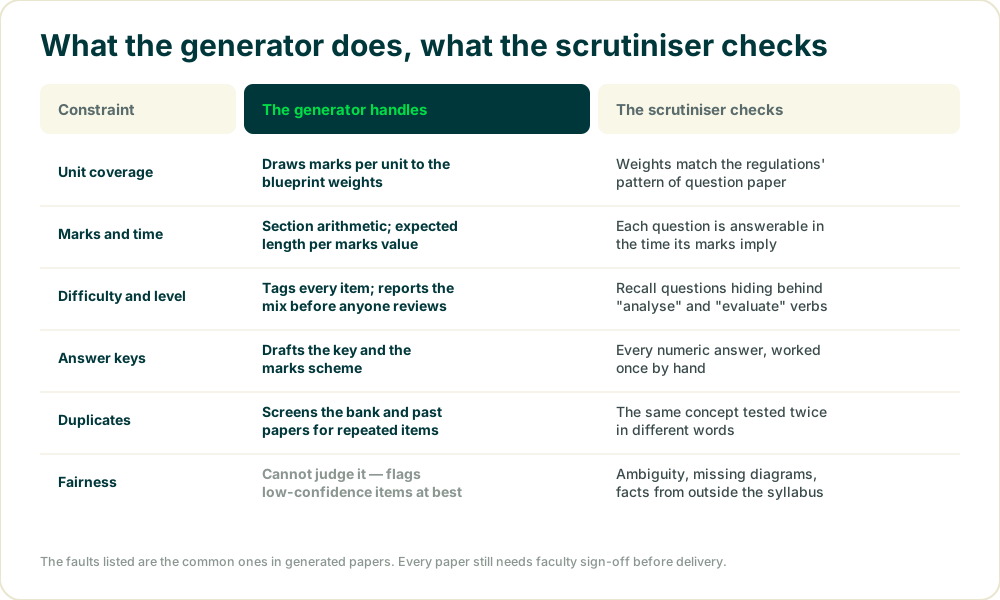
Generators are reliable at the accounting: coverage, marks arithmetic, difficulty and level tags, question-type variety, and drafting speed. They are unreliable in ways predictable enough to build a checklist around.
- Numerical questions. The stem may be fine and the worked answer wrong. Every numeric key needs a human to solve it once.
- Facts outside the source. If the model fills a gap with something it "knows", it may be wrong or off-syllabus. Anchored generation reduces this; it does not eliminate it.
- Ambiguous stems. Two defensible answers, or a question that depends on a diagram that is not there.
- Length mismatch. A "very short answer" question that needs a page, or a 15-mark question with a one-line answer.
- Near-duplicates. The same concept tested twice in different words, especially across sections.
None of these is a reason to avoid a generator; they are the review checklist.
Exam security when the paper is machine-drafted
Generation changes the security picture in two directions. The helpful one: a generator working from a large moderated bank can produce several sets of a paper at the same difficulty, which is what the UGC recommends for on-demand examinations — "a large question bank needs to be developed to generate different sets of question papers with the same level of difficulty". The same guidance asks institutions to change about 20% of a bank's questions every year, a job a generator makes routine.
The unhelpful one: if "AI question paper generator" means pasting your syllabus into a public chatbot, the draft paper has left the institution before the exam is set. A generator inside your exam platform keeps the paper in the system that will deliver it, with an audit trail of who generated, edited and approved what. And multiple sets are of little use if candidates can share screens — generation and AI proctoring belong in one platform.
The integration problem
Most generators end in a document. The paper is drafted, exported to Word, emailed to the scrutiniser, corrected in tracked changes, and re-keyed into whichever system delivers and marks the exam. The tags that made the paper balanced are lost at the first export, and two cycles later nobody can say which items have been used, where, or how they performed.
The alternative is a generator that lives inside the exam platform: blueprint, bank, generation, approval, delivery and item analytics in one system. Questions keep their tags, papers keep their history, and post-exam performance (which questions discriminated well, which were too easy) feeds the next blueprint. If you are also evaluating the bank side — tagging, moderation, reuse — our guide to question bank software covers it.
What to look for in an AI question paper generator
- A blueprint you define per paper — sections, marks, unit weights, difficulty ratio, Bloom's mix — rather than a "generate" button with a question count.
- Generation from your source material and your bank, with repeat detection against previous papers.
- Coverage accounting shown before review: marks per unit, per level, per difficulty.
- Question types that match your papers: long and short answer, numerical, diagram-based and case-based, beyond multiple choice.
- An approval workflow with edit, regenerate and reject, and a record of who approved what.
- Multiple sets at equal difficulty, published straight into delivery without an export.
How ExamX approaches it
ExamX treats the question paper as the unit of work, not the question. Faculty build a blueprint in the authoring module, point AI generation at their syllabus, notes or any other source content, and get a draft paper across 20+ question types with every item tagged for difficulty and Bloom's level. Approved items live in moderated question banks, papers move through the department's own approval chain, and the finished paper publishes to delivery — web, iPad or Android — inside the same platform that proctors the exam and evaluates the answers.
The proof point is SRM Institute of Science & Technology, which ran 80,000+ fully paperless exams across five campuses over 45 continuous days with zero disruptions; the SRM case study has the numbers.
Where it stops: ExamX does not remove the paper setter. The model drafts and does the accounting; whether a question is fair, on-syllabus and correctly keyed stays a faculty judgement, and numeric keys still need a human to work them once. It is also built for structured, high-stakes examination; a quick quiz for a Google Form does not need it.
AI question paper generator: FAQs
What is an AI question paper generator?
A tool that produces a complete question paper — sections, marks, internal choice, key and marks scheme — from your source material and a blueprint.
Can AI generate a question paper from a syllabus?
Yes, if generation is anchored to the syllabus and material you upload rather than a topic name; in ExamX every item comes back tagged by unit, difficulty and Bloom's level.
How is it different from a question generator?
A question generator gives you items. A paper generator starts from the blueprint, fills it, and shows the coverage accounting before anyone reads a question.
Does it follow Bloom's taxonomy?
As a target for each section and as a tag on every item, so the level mix can be checked against the blueprint. Recall questions wearing analysis verbs still need a human eye.
Do teachers still need to check the paper?
Every paper. Numeric keys, out-of-source facts, ambiguous stems, length mismatches and near-duplicates are the predictable faults.
Is it safe to use AI to generate exam papers?
Inside your exam platform, yes — one audited system from blueprint to delivery, with multiple equal-difficulty sets. Inside a public chatbot, your paper has already left the building.
The bottom line
A question paper generator is worth having if it starts from your blueprint, drafts from your material, shows you the coverage before you read a question, and hands the paper to the people who approve it without an export in between. Anything less is a question generator with a marks column. If your department or school sets papers against a fixed pattern every term, book a demo of ExamX and bring a real blueprint — the generator should be able to fill it in front of you.
UGC quotations from "Evaluation Reforms in Higher Educational Institutions" (University Grants Commission, 2019). Bloom's taxonomy dates from Cornell University's Center for Teaching Innovation. Product capabilities describe ExamX by Greatify.