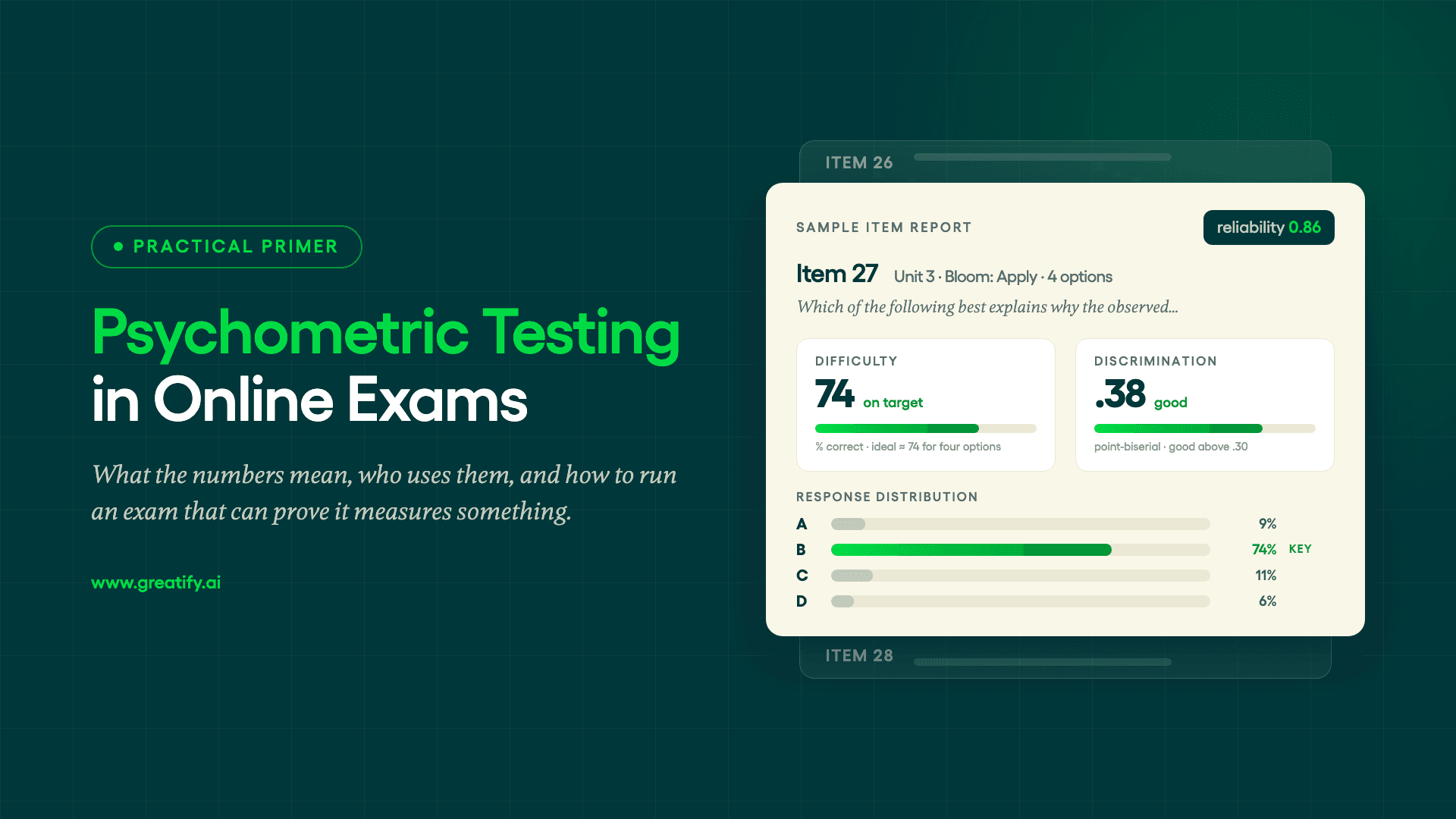
“Psychometric testing” means two different things depending on who says it. In HR it usually means a packaged aptitude or personality instrument a candidate sits before anyone reads their CV. In a university it more often means the statistics an exams office runs on its own papers to check that each question did its job. Both rest on the same discipline: measuring an ability or a trait with a score you can defend.
This primer covers the shared ground — what the tests measure, what psychometric testing software has to do, how to read the numbers, a workflow that holds up, the mistakes that undermine results — and says plainly where ExamX fits and where it does not.
What psychometric testing measures
A psychometric test is a standardised instrument that measures a construct — an ability, a skill, a trait or a body of knowledge — and reports a score whose meaning has been checked. Two properties decide whether that score is worth anything. Reliability is consistency: if the same person sat a parallel version tomorrow, would the score hold? Validity is whether the test measures the construct it claims to, for the decision you are making with it. A test can be reliable without being valid (consistent, but measuring the wrong thing). It cannot be valid without being reliable.
The reference document is the Standards for Educational and Psychological Testing, published jointly by AERA, APA and NCME since 1966 and now open access. Its core demand is simple to state and hard to meet: evidence for every intended use of a score.
In practice “psychometric” covers two families: trait and aptitude instruments, built and normed by a publisher against a reference population, and knowledge tests — entrance, certification, semester — built by the institution, where the psychometrics happen afterwards in item analysis.
Why HR teams use it
Volume first: when a campus drive attracts thousands of applicants, a structured test filters before a human reads anything. Then consistency: a validated instrument applies the same yardstick to every candidate, which reduces early-screening bias. And development — benchmarking existing staff.
Talent-assessment platforms such as Mercer | Mettl and Talview are built around this use: packaged instruments, norm groups, proctoring for remote candidates, and reporting shaped for recruiters. That is their home ground, and we say so on our own ExamX vs Mettl page.
Why academic institutions use it
Universities rarely buy personality inventories. What they need is evidence that their own high-stakes papers measure what the syllabus says they measure. India's UGC put this in writing in its Evaluation Reforms guidelines: it calls setting question papers through a question bank system “a much needed reform”, asks that every question be marked with its difficulty level, and recommends codes on each item for learning outcome, syllabus topic, difficulty and discrimination ability. That is a psychometric item bank in all but name.
The same evidence matters for entrance tests that rank applicants, certification exams whose pass mark carries a professional consequence, and any exam run in several forms.
Reading an item analysis report
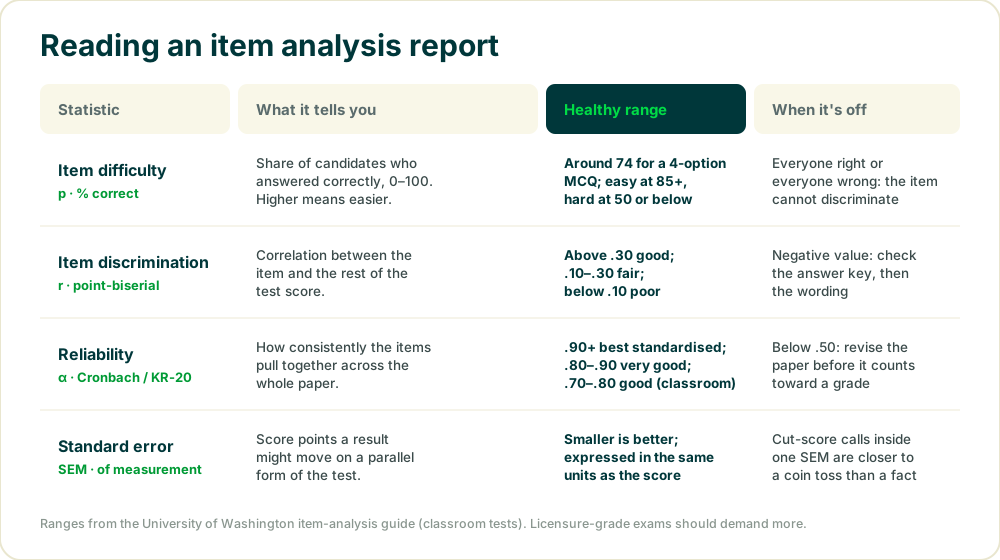
Every item analysis report carries four figures worth reading. The University of Washington's testing office publishes a clear guide to item analyses; its thresholds are a sensible starting point.
Item difficulty is the percentage of candidates who answered correctly, 0 to 100 — so a high number means an easy item. The most discriminating multiple-choice items sit a little above midway between chance and perfect: around 74 for a four-option question. UW labels items easy at 85 or above and hard at 50 or below.
Item discrimination is the correlation between getting the item right and the total score on the rest of the test (a point-biserial). Above .30 is good, .10 to .30 is fair, below .10 is poor. A negative value is a red flag: the item is mis-keyed, or the strongest candidates read it differently from the setter.
Reliability, usually Cronbach's alpha (or KR-20 for single-answer items), summarises how well the items pull together. UW rates .90 and above as the level of the best standardised tests, .80 to .90 very good for a classroom test, .70 to .80 good, and below .50 questionable. The guide also says the quiet part: high reliability “should be demanded” where a single score drives a major decision, such as professional licensure.
Standard error of measurement turns reliability into score points: the number to look at when a candidate sits one mark under a cut score.
Core components of psychometric testing software
Five capabilities do the work.
Item banking with psychometric metadata. Each item carries the outcome it targets, its cognitive level, its difficulty and discrimination from past administrations, and a version history. Without this the bank is a folder of questions, not an instrument.
Form assembly and randomisation. Parallel forms matched on content and difficulty, shuffled item and option order, and sets drawn from the bank on demand. The UGC notes that on-demand examination depends on a bank large enough to generate different papers “with the same level of difficulty”.
Adaptive testing. Computerised adaptive testing (CAT) picks each next item from the candidate's running ability estimate, so nobody is fed items far above or below their level. It needs an item pool calibrated under item response theory, which needs large samples per item — worthwhile for high-volume aptitude screening, rarely for a 300-student semester paper.
Proctoring that does not damage the measurement. A test measures nothing if the score belongs to someone else, but a proctoring experience that raises anxiety or fails a candidate's setup adds error of its own. Identity verification, a lockdown environment, and AI flags reviewed by humans rather than automatic penalties are the reasonable middle (our explainer on proctoring covers the options).
Analytics beyond pass/fail. Item-level statistics after every administration, distractor analysis, reliability per form and cohort performance — without a spreadsheet export first.
A five-step workflow that holds up
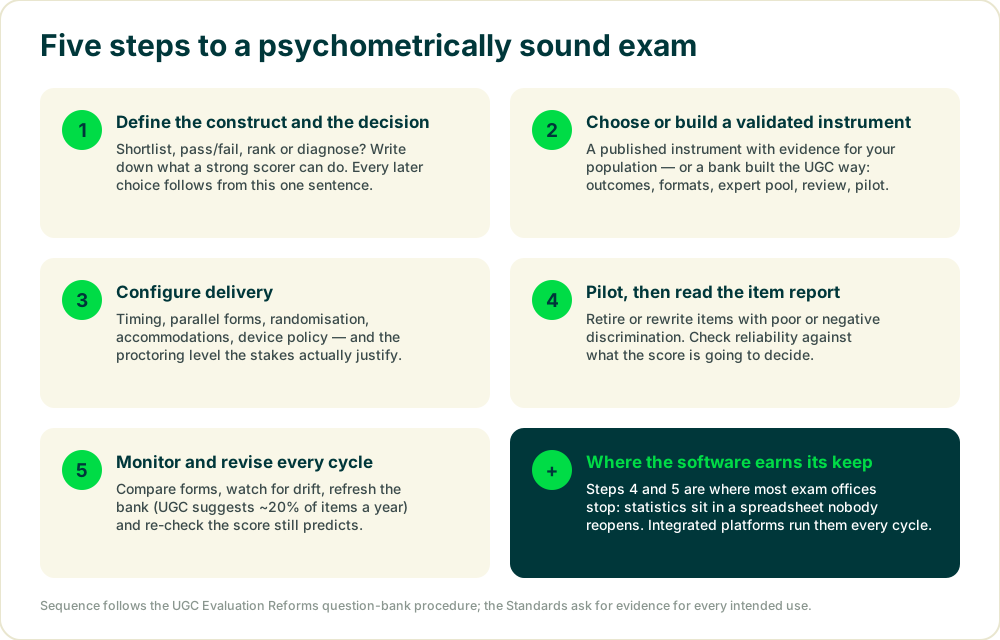
- Define the construct and the decision. Write down what the score will be used for — shortlist, pass/fail, rank, diagnose — and what a candidate who scores well should be able to do. Every later choice follows from this sentence.
- Choose or build a validated instrument. For a trait or aptitude measure, use a published instrument with validity evidence for your population and purpose. For a knowledge test, follow the UGC procedure: specify outcomes, decide formats, pool items from an expert panel, review, pilot, then assess difficulty and discrimination before final selection.
- Configure delivery. Timing, form assembly, randomisation, accessibility accommodations, device policy, and the proctoring level the stakes justify.
- Pilot, then read the item report. Run the paper on a sample, or treat the first live administration as a calibration cycle. Retire or rewrite items with poor or negative discrimination, and check reliability against what the score decides.
- Monitor and revise every cycle. Compare forms, watch for drift, refresh the bank (the UGC suggests changing about 20% of questions a year) and re-check that the score still predicts.
Common mistakes
Using an instrument outside its validated context. A reasoning test normed on graduate engineers says little about a nursing cohort, and a personality inventory built for staff development is not automatically defensible for selection. The Standards' evidence-per-use principle exists for exactly this.
Ignoring measurement invariance. If an item behaves differently for two groups of equal ability — because of language, a cultural reference or the format — the test is measuring group membership alongside the construct. Run differential item functioning checks whenever a test decides something.
Treating proctoring as optional at high stakes. Unproctored remote tests are fine for a first sift and unsafe for a final ranking. Match integrity controls to the decision, not to the budget line.
Conflating item difficulty with construct difficulty. An item can be hard because the concept is hard, or because the stem is ambiguous, the distractors implausible or the reading load heavy. Only the first kind tells you something about the candidate. Distractor analysis separates them: a wrong option chosen by the strongest candidates is a wording problem, not a knowledge gap.
How integrated platforms change the workflow
Traditionally the psychometric loop spans tools: the bank in one system, delivery in a second, proctoring in a third, then a CSV into SPSS or R and a memo back to the setters weeks later. Integrated platforms collapse that loop — item metadata lives with the item, each administration feeds its statistics back automatically, and revision happens where the paper was authored.
The payoff is frequency more than speed: when the analysis is cheap it happens every cycle instead of once per accreditation review. Specialist tools still matter for IRT calibration, DIF and equating; integrated platforms typically cover classical item analysis natively and should export the response matrix for the rest.
What to evaluate before committing
- Does the vendor publish validity evidence for the instruments it supplies, and for which populations?
- Which item statistics are computed natively, and can you export item-level responses for the rest?
- Can items carry outcome, topic, difficulty and discrimination metadata, as the UGC recommends?
- Is every proctoring flag reviewed by a human before it has a consequence?
- Can it deliver the formats your exams use — descriptive answers, diagrams, handwritten scripts — or only objective items?
- Verified peak concurrency, uptime and compliance (SOC 2, ISO 27001, GDPR) in the contract, not the slide deck.
A note on AI-generated items
AI can draft items fast, and drafting is the cheap part. An AI-written item is unvalidated on day one, exactly like a human-written one: tag it to an outcome, put it through expert review, pilot it, and let its difficulty and discrimination statistics decide whether it stays. Where AI helps most is coverage — candidate items across every outcome and Bloom's level, so reviewers have enough to reject.
Where ExamX fits — and where it does not
Start with what ExamX is not: a psychometric hiring suite. It does not ship validated personality or aptitude instruments, norm groups or adaptive testing. If you need a packaged reasoning battery for a campus recruitment drive, Mercer | Mettl and Talview are built for that job, and our guide to Mettl alternatives says which gaps each platform fills.
What ExamX is: an end-to-end online assessment platform for institutions that run their own exams — entrance tests, certifications, semester papers — and want the item statistics to prove they are sound. Faculty author papers with AI across 20+ question types with Bloom's-taxonomy coverage, from moderated question banks; delivery runs on web, iPad and Android with lockdown and offline mode. AI proctoring runs at 99.2% detection accuracy with under 0.1% false positives, every flag reviewed by a human with no automatic penalties. Rubric-aware AI evaluation handles descriptive and handwritten answers with faculty override — the formats most psychometric tooling ignores. And the moment a cycle closes, item analysis, difficulty and discrimination metrics and performance dashboards are in the system the paper was written in.
The proof is public: SRM ran 80,000+ paperless exams across five campuses on roughly 2,000 tablets, answer scripts ready to evaluate in about 10 minutes, zero disruptions across 45 days — details in the SRM case study.
Psychometric testing in online exams: FAQs
What is psychometric testing software?
Any platform that delivers standardised tests and produces scores with evidence behind them — normed instruments in HR, or an exam platform with a metadata-rich item bank and item analysis in education.
What is the difference between reliability and validity?
Reliability is consistency across parallel forms; validity is whether the score measures the construct it claims to, for the decision at hand. Reliable-but-invalid is common; valid-but-unreliable is impossible.
What is a good item discrimination index?
By the University of Washington's thresholds, above .30 is good, .10 to .30 fair, below .10 poor. Negative means check the key and the wording before the item counts.
Is ExamX a psychometric testing tool?
Partly. It computes item analysis, difficulty and discrimination metrics and performance dashboards for your own exams, but ships no validated aptitude or personality instruments, norm groups or adaptive testing — Mettl and Talview do.
Does psychometric testing require proctoring?
Depends on the stakes. Unproctored is fine for a first sift; once a score ranks, selects, certifies or fails someone, match integrity controls to the decision and keep a human review before any consequence.
Can AI generate psychometrically valid test items?
AI can draft them; validation comes afterwards, through tagging, review, a pilot and item statistics, the same as for any human-written item.
The bottom line
Psychometrics is a discipline before it is a product category: define the decision, use an instrument with evidence, read the item statistics, revise. Talent-assessment suites package that discipline for hiring. Institutions that write their own exams run it themselves, and the practical question is whether their platform makes the statistics a by-product of every cycle or a project nobody starts. To see what an item report looks like the morning after a real paper, book a demo of ExamX and bring your hardest exam.
Competitor capabilities summarised from each vendor's public product pages, September 2026. Verify current features, certifications and pricing directly with each vendor during procurement.